And I died nobly, like a man


Siren, by Robert Haas

Here is the poem I meant to write
But didn’t
Because you walked into my study
Without any clothes on.

I had just been thinking of how the Aegean sun
Must have lit up the faces of Troy’s fallen heroes
When you walked into my study
Without any clothes on—

Walked in and stood there,
Holding a glass of sherry
Over your left breast,
Which looked soft and firm as Brie.

Your tone of voice this morning
Should have warned me
That you might walk into my study
Without any clothes on.

I should have lashed myself to my chair
And stoppered my ears with wax.
But I forgot.
And I’m glad I forgot

Because when you walked into my study
Without any clothes on
You sang sweetly, sang sweetly,
And I died nobly, like a man.

The airless summer

Each morning, when I drive onto the Biltmore Estate to go to work, I drive by the cornfields, and I track the summer’s progress by its growth. A couple of weeks ago the stalks were standing between four and six feet high; now they’re well above human height, and in the late afternoon they cast the road into shadow. Summer has always been my least favorite season — I’m built for cold weather, both physically and temperamentally — but the growing corn makes me think of autumn, and crisp weather, and jack o’ lanterns. Reprieve is coming.

This is two weeks old. It's several feet higher now.

Mia is gone for most of the summer, which is another reason not to relish it. She’s down visiting her mom in Alabama, and I worry about her there. The apartment feels empty without her, of course. Her room, with her books and her dolls and her art projects, is a time capsule. The air in there is like a held breath. I need her to come back home and start the world moving again.

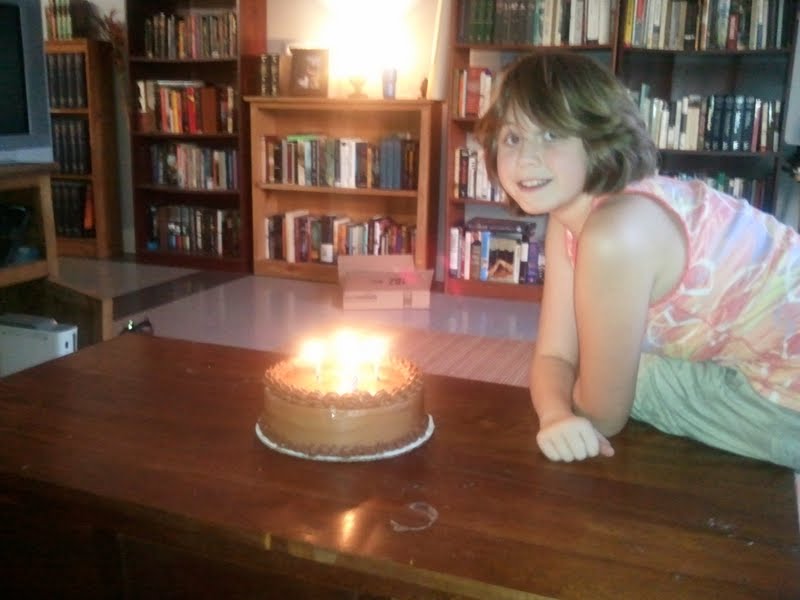
She was back for one week, though. We celebrated her eleventh birthday and went out to see some fireworks.

In the meantime, I have been filling the days. In June I went to the Sycamore Hill Writer’s Workshop, where I submitted a new story called “The Good Husband” for a critique. It was very well-received, and the problems the others found there were consistent with my own diagnosis, so the revisions are coming easily. The stories this year were of a very high caliber; I think my favorite was a very quiet, beautifully written apocalypse piece by Molly Gloss, called “The Grinnell Method.” This is what Andrea Barrett would write if she wrote about the end of the world.

The workshop cabin at Sycamore Hill

So there are revisions to finish, and the novel to write, and the cannibal priests which have been too long neglected.

And soon my little girl will be home again, and we’ll be spending all of our energies getting ready for sixth grade, and the new school. And then the corn will be ready for harvesting, and the temperature will break, and I will be able to breathe again.

“The Way Station” is a love letter

A few days ago Naked City: New Tales of Urban Fantasy hit the shelves. This one features “The Way Station,” which is kind of like my farewell-to-New-Orleans story. This book has been a long time coming, and I’m glad people will finally get a chance to read it.

This one is special to me, for a couple of reasons. In some ways it’s about how the city haunted me for years after leaving, and how hard it was to let it go. I’ve said before, perhaps excessively, that New Orleans was the first place I truly felt at home. It still makes up a large part of my heart’s country. Beltrane, is loosely based on a homeless man named Sunbeam who used to come into the Pub. He was dearly loved by the regulars, ad when he passed away it was a hard day for more than one of us. Sunbeam will soon be getting a post of his own here; he wrestled bears in his youth, after all (a detail which does not appear in the story).

This is also the first story I ever wrote as a love letter to a woman. Every sentence was spun by her eyes in my mind. I wanted it to be beautiful for her. Perhaps it’s an odd love letter — but I’m not a particularly normal man.

So this one has special relevance to me for these reasons. Looking at the cover art, I can’t help but think readers diving in for Dresden Files-type stories will be baffled or frustrated by it. But it’s a good one, I think, and I’m proud of it.

An excerpt:

“I was haunted once too,” Davis says quietly. “Then the ghost went away.”

Beltrane stares at him with an awed hope as Davis slowly fishes through his pockets for a lighter. “How you get rid of it?”

Davis lights both cigarettes. Beltrane wants to grab the man, but instead he takes a draw and the nicotine hits his bloodstream. A spike of euphoria rolls through him with a magnificent energy.

“I don’t want to tell you that,” Davis says. “I want to tell you why you should keep it. And why you shouldn’t go see your daughter tomorrow.”

Beltrane’s mouth opens. He’s half-smiling. “You crazy,” he says softly.

“What do you think of, when you think of New Orleans?”

He feels a cramp in his stomach. His joints begin sending telegraphs of distress. He can’t let this happen. “Fuck you. I’m leaving.”

Davis is still as Beltrane hoists himself out of his chair. “The shelter won’t let you back in. You said it yourself, you gave up the bed when you left. Where are you going to go?”

“I’ll go to Lila’s. It don’t matter if it’s late. She’ll take me in.”

“Will she? With streets winding through your body? With lamps in your eyes? With rain blowing out of your heart? No. She will slam that door in your face and lock it tight. She will think she is visited by something from hell. She will not take you in.”

Beltrane stands immobile, one hand still clutching the chair, his eyes fixed not on anything in this room but on that awful scene. He hasn’t seen Lila’s face in twenty years but he can see it now, contorted in fear and disgust at the sight of him. He feels something shift in his body, something harden in his limbs. He squeezes his eyes shut and wills his body to keep its shape.

“Please,” Davis says. “Sit back down.”

Beltrane sits.

“You’re in between places right now. People think it’s the ghost that lives between places, but it’s not. It’s us. Tell me what you think of when you think of New Orleans.”

Sycamore Hill and the goal for the summer

In a few weeks I’ll be attending the Sycamore Hill writers’ workshop in Little Switzerland, NC. I went once a couple years ago, and workshopped my werewolf story, “Wild Acre” (appearing later this summer in Gary McMahon’s anthology Visions Fading Fast, he added in his best huckster’s voice). The story had been struggling to find its title until Karen Joy Fowler gave it to me there. It’s a friendly but intense environment, kind of like Clarion with brass knuckles. I’m looking forward to going back.

I’m racing to finish the new story on time. This is also the last story I have to finish before sending the manuscript of the collection to an interested publisher, so there is extra incentive to get it done. It’s going to be a watershed moment.

Also this summer I have taken up Theodora Goss’s YA challenge. Now, I’ll be honest here: I usually steer very, very far from this kind of thing. A friend of mine calls it a stunt, and I have to acknowledge that it has that veneer to it. I feel the same way about NaNoWriMo. I always thought that if you’re a writer you just write the damn thing and it takes as long as it takes.

But I took this up for a couple of reasons. One, this isn’t being done as a stunt. Not by Dora, and not by Livia Llewellyn or Alexandra Duncan (who are also taking part; Dora has the full list over at her site (I can’t speak for the others, since I don’t know them, but I will assume their intentions are noble (looking over the list again, I notice with some amusement that I am the only man represented there; do I care about this branch of literature more than most men because I’m a single parent? Hmmmm … (But I digress)))). I don’t think anybody gives a damn what the world at large things about the endeavor. Two — and for me this is the crux of it — I have always been an undisciplined writer, and I’m working to change that. While I believe an undisciplined writer can produce great fiction, it’s almost a given that there will not be much of it. Furthermore, it’s all but impossible to develop professional momentum without a rigorous work ethic.

I am very comfortable with the idea of letting the work stand on its own. At the end of a writer’s life, and afterwards, readers don’t talk about how quickly that writer produced, or whether or not he adhered to a daily word count. They could give a shit. What they care about it what’s on the page. The result is what matters. I believe that fundamentally.

That being said, I don’t like the fact that I don’t have books out yet. My ego wants that gratification. I want to do readings and sign books, because ultimately I am a vain man. All writers are narcissists on some level. And this will be a great stride toward that end.

Finally, and most importantly: I have this great idea. It’s been sitting in my head for a while. It’s perfect for a young adult audience, I think. It’s something I haven’t read before, and I’m excited by it. So what the hell. The pieces are in place. Why not take advantage?

So here I go.

The Cannibal Priests of New England, part five

V. The Carrion Angels

There were four of them. They emerged from the lantern-smoked alleyways of the nameless port town, building themselves from shadows and burnt rags. Seven feet tall, their thin bodies wrapped in fluttering black cloth, they listed back and forth as they walked, their bones creaking like the rigging of ships. Their heads were hunched and birdlike, fleshless jaws underslung and tooth-spangled, red eyes trailing coils of smoke.

They stalked the narrow avenues of the town with measured deliberation, going unseen by most of the population, and sending those few that did see them shrieking and scattering like frightened gulls. Some of the more foolhardy among them turned and fired a few wild shots before running. The carrion angels were oblivious to all of it, their bodies accepting the violence they way a corpse accepts the worm. They swung their great heads toward each juncture of road and alley, lifting their snouts and huffing deep breaths as they tracked the scent.

They followed it to a darkened warehouse where they found the corpse of William Thickett, the back of his head cratered and his brains splashed across the stacked crates and the packed earth. The stink of it made them drunk and they lost focus for a moment, hunched around this glorious fountain of scent, this unexpected confection. But they remembered their duty. Turning aside for the moment, they creaked slowly through the warehouse.

They knew almost immediately that the heads had been taken.

The trail resumed at the bay door, wending down toward the docks. But before they pursued it, they returned to the feast that had been left them. They surrounded the body of William the Bloody and stooped to feed, lowering their heads into the bowl of his corpse. They ate with a grateful reverence, the sound of wet meat and cracking bone giving measure to an almost absolute darkness.

Outside, the town had erupted in a panic. Word of the carrion angels’ presence had spread fast and the narrow roads were choked with men fleeing for their ships. Pirates and sailors careened drunkenly, lurching, stumbling, trampling the fallen. Throughout the town panicked men shot and stabbed at shadows, and the road to the sea was marked by the bodies of the dead and the dying. Most of the women stayed inside, shuttering the windows and locking the doors; others, often the youngest and least experienced, followed the pirates to the docks, forgetting in the terror of the moment the temperament of these men, and remembering only when they were beaten back or shot as they tried to climb the gangplanks to safety.

The ships were alight with lanterns, riggings acrawl with sailors making ready for the sea. Boats were dropped from the sides and men were set to towing the vessels from the port. Gunsmoke hazed the air and the bloom of violence was a grace upon the town. They walked in their slow, swaying gait through it all, like four tall priests proceeding sedately through hell, confident in their faith.

The scent ended at the docks. The crate of heads had gone to sea.

It was a small thing to sneak passage aboard a ship. The carrion angels dissolved into rags and dust, blowing like so much garbage in the wind, carrying over the water and into the rat-thronged hold of one of the several pirate ships, settling amongst the refuse and lying as still as the dead.

The captain of this very ship, a hard old man called Bonny Andrew, who harbored a longstanding terror of these creatures yet misjudged their physical nature, waited until they had reached some distance from land and ordered his ship to turn about, offering its broadside to the town. At his command the ship fired its complement of guns in a poorly orchestrated yet devastating volley, sending cannonballs smashing through weak wooden walls and bringing whole buildings to the ground. Another ship took inspiration from this and fired as well.

Within moments the nameless port town and its luckless residents were reduced to broken wood, and smoke, and blood. The pirates, satisfied at their own efficiency, rounded out to sea, dark under a moonless night.

The carrion angels slept in the hold. The scent’s trail was a road, even over the sea. They were sure of their step.

Kid fears

Last night Mia was sitting on the counter while I puttered around in the kitchen. She was talking about the last science project of the year, due two days before the last day of school. It involved dropping an egg from the roof in a box designed to keep it from breaking. I was only half paying attention. She said, “I can’t believe I’m leaving this school in seventeen more days.” I nodded and said something like I know or It’s pretty crazy, isn’t it? And then she said, “Do you think anybody there will remember my name?”

I looked at her. She was staring back at me, and she had that intent, serious look on her face that indicates big emotions held in check. “Of course they will, sweetheart,” I said, and put my hand on her head. “Are you worried about that?”

She nodded and started to cry.

Next year she’s not going to the middle school the rest of her friends are going to. She was accepted to Hanger Hall School for Girls, a private school focusing on grades six through eight. She was thrilled to be accepted, and with its smaller classes and more intensive curriculum — not to mention the female-positive aesthetic which characterizes the place (when I visited the first time I noticed the walls were covered with biographical posters the girls had done, all focusing in women in history — Joan of Arc, Harriet Tubman, Coco Chanel, Hillary Clinton … ) — I’m thrilled she’s going there too. On the day she received her acceptance, as I was tucking her in that night, she said, “Daddy, tonight I’m going to dream happy dreams about middle school.”

I’m fairly certain that sentence has never been uttered before, in all of human history.

Nevertheless, the reality of it is beginning to sink in. She’s worried about being forgotten. “I feel like I’m drifting away from my friends,” she said, citing two in particular. “I don’t think people even know my name.” She thought for a second, and said, “They just know me as the sensitive girl.”

Which is code for the girl who cries easily.

I assured her that she was leaving a much better impression than she realized, and that we all tend to think of ourselves more harshly than other people do. I told her to gather the names and phone numbers of her friends so she could stay in touch; we would have sleepovers and picnics. Regarding the impression she feels she’s leaving behind, and the friends who are already starting to drift away from her, I told her I did not find friends who lasted more than a year until I got to high school. And I reminded her that one of the good things about going to Hanger Hall, with all its new faces, is that she could have a fresh start. She didn’t have to worry that because she cried a lot in the third grade, everybody still remembers it and judges her for it. She could present the face she wanted to present, and begin anew.

Of course, you always carry yourself around with you. I was struck by how many of her fears are the ones we carry with us our whole lives. How they reflect my own fears when I stare at the ceiling in the middle of the night. I don’t want to oversell the idea of a clean slate to her; I am well aware of the dangers of learning too well the lesson of flight.

But sometimes it is just the thing. I have reinvented myself more than once in my life, and most of those times I have been been invigorated by it. I can be excited by the prospect of radical change because to me it suggests the possibility of a better paradigm; but then, I have my own life to teach me that. This is brand new for Mia. She has been at this school and known these people for a little over half of her life. She’s both excited and terrified. She’s both elegiac, and crackling with possibility.

It’s a strange and humbling thing, watching your small child wrestle with truly adult emotions. You give lots of hugs. You guide as best you can. And because you know there are hits that cannot be avoided, you hope that it’s enough.

Night cook

I was the night cook. We were on a rig out in the Gulf, many miles from shore. There was a skeleton crew; we were all just there to keep the parts moving. I would wake up around three in the afternoon and get down to the kitchen about an hour later. Have something to eat and some bad coffee and get to work.

I’d help the head cook get dinner squared away. Set out the food and sit back as the roustabouts came in and slopped it onto their plates and wolfed it down. They sat around and talked about sports and girls and how much longer they could count on this job. It was like a high school cafeteria except this time the anxiety was about when you would go broke and who was fucking your wife while you were away on your three-week stints.

After dinner they all filed out and we broke everything down, cleaned it up. Then the head cook would sit down and eat something himself, and go off to bed. Each shift was twelve hours; he would not be back in the kitchen until six the next morning. I’d get things ready for the night time stretch.

This was the easiest offshore gig I ever had. All I had to do was prepare a snack and have it out at around midnight, and be sure to leave it up for an hour or so for the few luckless souls who happened to wake up. Usually this was nobody. Later I would ready breakfast, though my shift would end at four and I wouldn’t have to actually serve it. Just have it ready for when the day cook came in the next morning.

This left an abundance of free time.

I did a lot of reading. I read Tropic of Cancer out there, and thought about the girl I was seeing back home. We’d worked together in a bookstore before I took this job and I liked to imagine her walking through the tall stacks, graceful and lovely. I thought about reading pages of the book to her, speaking aloud that rough and gorgeous language, saying things to her I did not have the courage or the knowledge to say myself.

I wrote some stories. Little vignettes in the naturalist style that seemed terribly important to me at the time. I assembled them into a little volume I thought I would publish as a chapbook somewhere, called Slaughterhouses. My head was full of Miller and Faulkner and Thom Jones. I had stopped reading fantasy some time ago and did not then believe I would ever go back to it.

Sometimes someone would straggle in for some coffee and a wedge of refrigerator-flavored cake. Sometimes we’d talk and sometimes we wouldn’t.

By the time two o’clock in the morning rolled around I was usually the only one awake on the whole rig. The work in the kitchen was long done and you can only read in that awful florescent light so long before it becomes a cudgel and you have to walk out of it or go insane.

My favorite place to go was the helicopter pad. It was always empty, except on Thursdays when some of the crew would rotate out. The wind was hard up there. In the daylight, all you could see for miles around was flat blue water. But at night the lights from distant rigs ringed the horizon and you felt a part of some vast, strange city.

I would lie down on the helicopter pad and stare straight up into the stars. There was no light out here and I was at the highest point on the rig. I could see the white smoke of the Milky Way. I felt the planet press against my back, pushing me through the darkness.

Sometimes they come back

I went to Clarion way back in 1992. It was a great class. Jeff VanderMeer, Cory Doctorow, Dale Bailey, Felicity Savage.

Me.

And Pam Noles. She was dynamic, crazy smart, opinionated, funny, and beautiful. I was struck. I think a few of us were.

A couple years after Clarion she came to visit me in New Orleans and something happened. I was on fire. And then time and distance and a variety of other factors did their ugly work and we fell out of each other’s lives. But I never stopped thinking about her. Never stopped keeping track.

And now, after a fluke exchange, and a buckle in the wind, here she is again. Suddenly and miraculously. And just in time.

Taken by Kathleen Ann Goonan last weekend. Ignore that creature shining palely in the sunlight. Look at the woman instead.

A brief return to the city, part two

When I drove in it was as though New Orleans pulled out all the stops to welcome me. I got in at the evening rush hour, and the I-10 coming in was clogged with traffic. Behind me somewhere a siren erupted; I looked into the rearview and saw an ambulance trying to bull its way through. It took a long time for it to pass me; I imagined someone hemorrhaging blood on a sidewalk, someone struggling for breath on their living room floor.

I avoided the long train of cars veering towards the St. Charles exit and the bridge crossing to the Westbank, electing to take Claiborne Avenue instead. This was the way I used to ride the motorcycle home from the university every day. I turned left onto MLK, which is a wide thoroughfare split by a generous neutral ground. A block in and I had to slow to a crawl as a huge congregation of people surrounded two young guys pounding the shit out of each other. It broke up fast, or maybeI just arrived at the tail end of it; two women pulled one of the boys away and one of them turned to shout back at the crowd: “Y’all gonna see! Y’all gonna see!

Later that night I went to the French Quarter with the bride and groom and the bride’s family for dinner at the Court of Two Sisters. I came up from Decatur, avoiding the major tourist crowds on Bourbon Street. You could still walk down the side streets and look into open doors and see topless women, older and sadder this far from Bourbon, wearily circling a pole. Grandpa Elliot, the old harmonica player who recently discovered a measure of fame with Playing For Change, still sat on his overturned bucket, busking through the night. When I passed him that night he was leaning back, quiet, staring into the middle distance. The crowds moved around him like water around stone.

When I moved to Asheville again a few years ago, I was shocked by how white the city is. After spending so many years away in New Orleans and, to a lesser degree, in New York, I had forgotten that about it. It took me a long time to acclimate to its monochromatic nature. And going back to New Orleans, I realized how much I had acclimated. It was such a welcome feeling to get back to a place where cultures mixed and clashed and blended. On my last night there I was sitting in a restaurant and, thinking about this, I did a quick scan of the clientele. At least half of them were black.

This is it, I thought. This is my city.

After my last post, I got an email from Monte, one of my old friends and one of the regulars at the Pub during my time there. Monte has since moved to Tampa, where he is married to Maura, another friend and Pub regular. He reminded me that I could not go back and expect to find the old place, because that place was made up by the people. Monte and Maura, Craig, Jim, Violet, Beth, Neal, Jon and Molly, Evan, Ginger, Jon and Vanessa, Darren, Ingrid, Sobha … I could fill a whole page with their names. They were mostly scattered, and that time was done.

And of course he’s right. Sometimes you shouldn’t go back with the intention of recreating something from the past, or trying to find it again. Sometimes you should just let good memories be good memories.

But it was nice to see that there is still so much to recognize. Maybe one day I’ll go back there. I don’t think Asheville is where I’m going to settle down.

At the very least, crossing the Pontchartrain bridge in the middle of a lonely night on the motorcycle will always be a thrill.