Leviathan 5 is coming

Jeff and Ann VanderMeer are gearing up for the fifth volume in the astonishing Leviathan series of anthologies. All four volumes occupy a position of pride on my shelves. It is through these books that I first encountered the beautiful and exciting work of writers like Stepan Chapman, Michael Cisco, Rikki Ducornet, Ursula Pflug, and Rhys Hughes. They are like nothing else I’ve read, and I believe they were instrumental in kicking open a lot of doors in our corner of the fantasy genre. Although they never received as much press, I remain convinced that they were as influential on the tenor of the field as Dangerous Visions, although their influence was more subtle, seeping into the groundwater and changing not just how we want to write imaginative fiction, but how we define it.

Jeff and Ann have decided to focus the fifth volume on newer writers, “probably defined as writers with two or fewer books published in English.”

Note that last clause. To wit:

“We are going to do something fairly unprecedented in the history of genre and have between 15 and 20 associate/foreign language editors in other countries so that many writers who do not write in English would be able to submit. Up to 30,000 words of the 100,000 words might be fiction newly translated for Leviathan 5.”

To help fund this endeavor, Jeff is diverting all royalties from his short story collection The Third Bear and his forthcoming nonfiction collection Monstrous Creatures to the project.

One of the things I have always admired about Jeff and Ann is their full commitment to their ideals. This is a perfect illustration. This anthology is deserving of your full attention.

Direct donations are also possible. Go here to get all the details you’ll need.

The Cannibal Priests of New England, part one

1. Tortuga, 1662

Palm trees heaved in the night wind. Between them he made out a heavy layer of stars, like a crust of salt on heaven’s hull.  A briny stink filled the air, reminding him of how very far from home he was. The sea was calm tonight and the waves made a steady hush against the shore.

Behind him the small port town gabbled excitedly to itself: fiddles and croaking voices lifted in song like a chorus of crows, voices raised in anger or friendship, the calling and the crying of girls and women. It sounded like life, he supposed. No wonder it made him ill.

A shape lurched toward him from town: a man, fat and stumbling, a rag-wrapped something in his left hand. He navigated the sand with difficulty. The smell of rum blew from him like a wind.

“Martin,” Fat Gully said. His voice was thick. “What’re you.”

“Are you attempting to speak?” said Martin. “I’m taking some air. Please go away.”

“Nonono,” Gully said, his words sliding together and colliding. “No you don’t. No you fucking don’t.”

Martin controlled his voice. “No I don’t what.”

Fat Gully crashed down onto his butt, his fall cushioned by the sand. The thing in his hand looked bloody. “No you don’t take on no high-born airs with me, you fancy bastard. I’ll peel you standing, fat purse or fucking not.”

Martin wore his rapier, but he had seen Gully and his wicked little knife in action and was not eager to test him, even in his diminished state. Instead he turned his gaze to the gory rag in Gully’s hand, which had begun to leak a thin black drizzle onto the sand. “What in God’s name do you have there?”

Gully smiled and climbed slowly to his feet. The lights of the town behind him cast him in shadow as he extended his arm and opened his hand; he looked like a thing crawled from hell.

Martin inclined his head forward to see, raising an eyebrow. It took him a moment to make sense of it.

“I know what you’re about,” Gully said, a dull smile moving across his face. “I want a seat at the table.”

“I don’t know what you mean by showing that to me, but I assure you I have no use for it. Get rid of it.”

“You’ll learn not to bark orders at me, Mister Dunwood,” Gully said, rewrapping his dreadful trophy and securing it in some mysterious inner sanctum of his jacket. He did not seem in the least disappointed by Martin’s dismissal. If anything it, he appeared cheered by it. “Oh yes you will. We’ll see what it means once we get there, won’t we?”

For the first time in a long week Martin felt something inside him lighten. “‘Once we get there.’ Have you found us passage then, Mr. Gully?”

“I have indeed,” said Gully, smiling again. He turned about and made his tentative way back to town. A pistol cracked in some ill-lit alley and a cry of pain rose above the cacophony of voices like a flushed bird. Gully lurched in its direction, his purpose steady. “Come and meet our new benefactors, Mr. Dunwood. We ship with the tide.”
A brief introduction to the cannibal priests

I’m going to try an experiment. I’m going to write a serial on this blog.

I tend to be a very methodical writer. I revise as I write, which can make the completion of a story a slow process. I like to polish my sentences and harmonize my themes as much as reasonably possible before I send a story out into the world. Generally I think the finished product is worth the extra time. The downside of this, though, is that there is always a risk of getting so bogged down in the minutiae of a paragraph or a scene that work stalls. Sitting down to work on it can become a chore, when it ought to be fun.

I’m working on three projects concurrently right now. The past few days they’ve all come to a place where careful thought and hard labor are required to move them along. That’s fine — it’s nothing new. But rather than not write for a few days or a week, which is what I would have done before, I’m going to try something different.

I’m going to start up another work, altogether different in style, setting, character — just about everything. I’m going to write in quick bursts, probably no more than a few hundreds words in a sitting. I will not revise and, most importantly, I will not plan ahead. This is going to be a blind charge into darkness. I’m not allowed to fret over this. The whole purpose is to keep my mind fresh and to keep myself limber while I work on bigger projects.

So. I picked a title that’s been sitting in my head for a couple of years but never managed to find a story: “The Cannibal Priests of New England.” I picked a setting that sounds romantic and fun: Tortuga in the 17th Century, in the golden age of pirates. That’s all. Everything else I will make up as I go along.

I’ll post a new installment at least once a week. More, if I feel a strong need — but once a week at the very least. You’ll notice a new page linked at the top. I’ll post the updates here, in the main body of the blog, and archive the posts on that page so they’ll be easy to find. Because the point of this is to write freely and quickly, I will not make any effort to censor myself. It will be written for grown-ups.

This may turn out to be embarrassing; I’ve never thrown first draft material out into the world like this before. I’ll probably write myself into corners more than once. But that’s okay. It’s not meant for posterity. It’s a self-imposed high wire act, meant to keep me honest and to keep me working. With luck, we’ll both enjoy it.

Slog

Today has been a slog. I’m throwing words down and hoping they make sense. I’m not sure they do. This post, for example, is comprehensible to me as I write it, but I’m not entirely convinced it won’t appear to everyone else as something along the lines of fjshej jqkjdmwj 277bnfjuf df jjd.

I know, of course, that this is part of the process. That the trick is to write the gibberish anyway and not let it chase you away from the work. The trick is to not fall in love with the delete button. That button will be there tomorrow, and if the words do prove to be nonsense I can erase them then.

I have to remind myself of this. I have to remind myself to keep laying down words and sentences like railroad ties, and if I forget what it is that I’m doing or why I’m doing it, to trust in muscle memory to see me through. Trust that I’m building a path that leads somewhere I want to go.

I don’t want to write this weird little post. I’m doing it because I have to. Because I think it matters that I do it. If only to me. The work matters. The simple action of it.

Writing is an act of faith.  I’m not an atheist anymore.

The consolations of winter

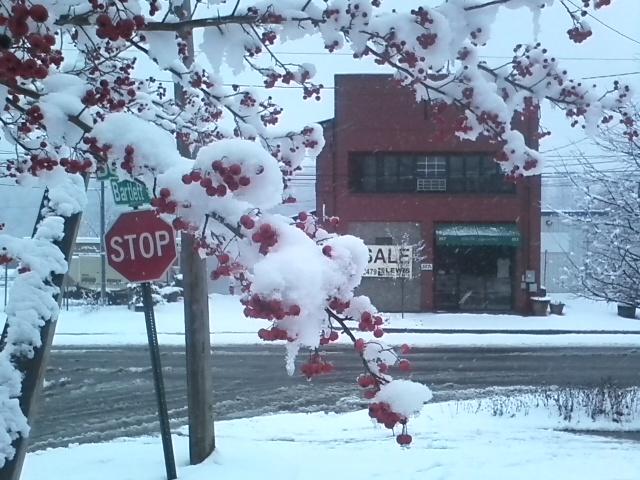
I love the winter. I love snow fall, I love the piling drifts. I love the cold weather. I realize this places me in a vanishingly small minority. I don’t care; it wouldn’t be the first time.

I was born in Massachusetts but both of my parents spent the first portion of their lives in Thief River Falls, Minnesota. My ancestry is heavily Norwegian. I would think  that a love of cold climates is inherent in my blood, except that my parents moved to Florida shortly after I was born precisely to escape the winters of the North. But when I look at photographs of snow-covered pines, of icy cliffs, of long fields blanketed in white, I feel a tugging in some unnamed place inside me. Particularly when I look at pictures of Scandinavia. Is there a word that means feeling nostalgia for a place you’ve never been?

Winter calms me. I like the clothes I’m forced to wear: heavy and dark, so that I’m turned into a smudge of ink on a white page as I walk the two blocks from my apartment building to Clingman Cafe, where I go for coffee and warmth and the pleasing company of strangers. I like the bright feeling in my lungs as I inhale the icy air. In winter the light comes to earth at an angle which sharpens detail. It is a lean season, a season for the paring away of excess. It reduces the world to its essential nature, and I feel called upon to do the same thing with myself. I organize my home, I organize my mind and my heart. There is so much clutter, and it is a pleasure to get rid of it all.

These are pictures taken from the living room window of my apartment or, in the case of the tree, just outside my building. I can go all year without picking up a camera, but when the snow falls I find I am taking pictures of everything I see. I want to remember it all when the summer threatens to smother the life out of me.

My friend A, who hates winter with the whole of her Southern soul, sent me this poem yesterday, which says it all better than I can:

Zero Holding, by Robyn Sarah

I grow to like the bare
trees and the snow, the bones and fur
of winter. Even the greyness
of the nunneries, they are so grey,
walled all around with grey stones —
and the snow piled up on ledges
of wall and sill, those grey
planes for holding snow: this is how
it will be, months now, all so still,
sunk in itself, only the cold alive,
vibrant, like a wire — and all the
busy chimneys — their ghost-breath,
a rumour of lives warmed within,
rising, rising, and blowing away.

You’ll all get your endless summer soon enough. I’m going to love the winters while we still have them.

Vampires in the sun

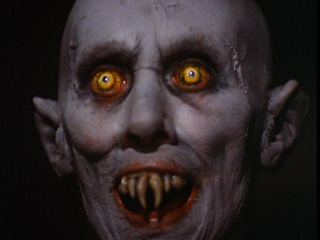
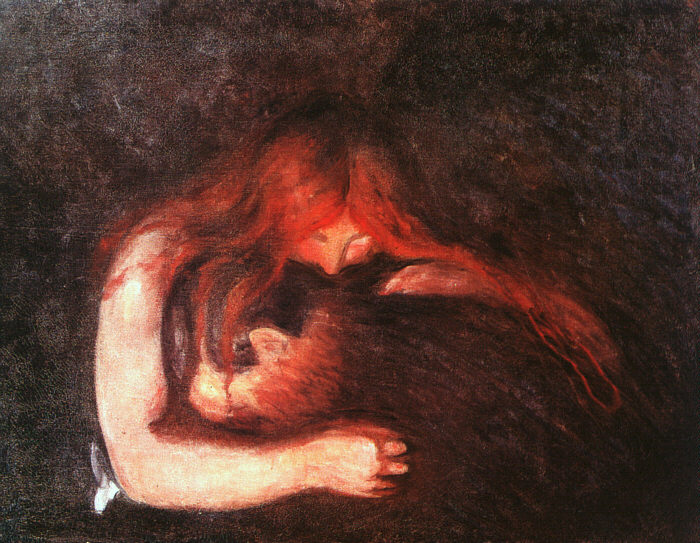
A little while ago I was talking to Theodora Goss about vampires. She was in the midst of writing a Folkroots column about them, and I have a vampire short story appearing in a forthcoming anthology called Teeth, edited by Ellen Datlow and Terri Windling. They’re everywhere these days, of course: you can’t walk out of your home without stumbling over one of the dismal little bastards. We both had some opinions on the matter, as you might expect, and we thought it would be interesting if we both posted on the subject. You can read hers here.

I have avoided vampires for most of my adult life. I think my last real encounter with one was in Anne Rice’s The Vampire Lestat, which I enjoyed. (I tried and failed to read any more of those increasingly dreadful books.) My first was in the televised version of ‘Salem’s Lot. I can probably trace my love affair with horror fiction to watching that movie as a little kid. My mother worked night shifts at the hospital back then and my brother and I were left alone in the house after seeing it, quaking with mortal fear. She fashioned crosses out of tongue depressors for us, which is the only reason I’m alive to write about it now.

And then of course there was Dracula.

I don’t need to recount to you here the sad decline of the vampire in the days since. They became be-glittered romantic heroes. Vampires have been neutered, ironically enough, through sexualization. We can have dangerous lovers but we’d rather not have murderous or evil ones.

When I was asked to write a story about vampires for Teeth I saw it as a chance to reclaim — for myself if for no one else; for that terrified, deliriously excited little boy I used to be — the terror of a vampire. My vampire would burn in the sun. My vampire ached to open your veins. My vampire would be beautiful, but not in the way we had come to expect them to be. My vampire would be beautiful the way a great white shark is beautiful.

I wanted to acknowledge, in a small way, what the vampire has become. I thought that if a vampire would be forced to live in our world it would have to rely on seduction as a means to snare prey. But there are so many modes of seduction beyond the sexual. I also wanted to show how psychologically dangerous they were. That no matter how they looked or what their circumstance, they were predators to the end. Finally, my vampire had to be scary. A thing that haunts the darkness and breathes fear.

In “Sunbleached” my vampire begins the story with its back against the wall. It’s been burnt almost to death by the sun, and is hiding in the crawlspace of a collapsing house on the Mississippi coast. A boy finds him there. Each has an agenda. And so it begins.

The vampire moved in the shadows, and abruptly the stink of burnt flesh and spoiled meat greased the air. It had opened a wound in itself by moving. Joshua knew that it tried to stay still as much as it could, to facilitate the healing, but the slowly shifting angles of the sunbeams made that impossible. He squinted his eyes, trying to make out a shape, but it was useless. He could sense it back there, though – a dark, fluttering presence. Something made of wings.

The vampire coughed; it sounded like a snapping bone. Something wet hit the ground. It moved again, this time closer to the amber light. Its face emerged from the shadows like something rising from deep water. It hunched on its hands and knees, swinging its head like a dog trying to catch a scent. Its face had been burnt off. Thin, parchment-strips of skin hung from blackened sinew and muscle. Its eyes were dark, hollow caves. Even in this wretched state, though, it seemed weirdly graceful. A dancer pretending to be a spider.

Teeth is a Young Adult anthology — a fact which gives me no small pleasure. Most of the people picking up this book will be accustomed to the diminished vampires of our own time. I’m happy to give them something different, something older and deadlier. At first I was hesitant to write this kind of story for a YA audience. But it was around thirteen or fourteen years of age that I graduated beyond the television and picked up Stephen King’s novel for the first time. It was like a priest’s first Bible.

Vampires ushered me into the world of the night creatures. “Sunbleached” is my love letter to them, and a reminder — to myself as much as to anyone — there is is still something evil and cold and hungry at the heart of the myth.

Surface detail in imaginary places

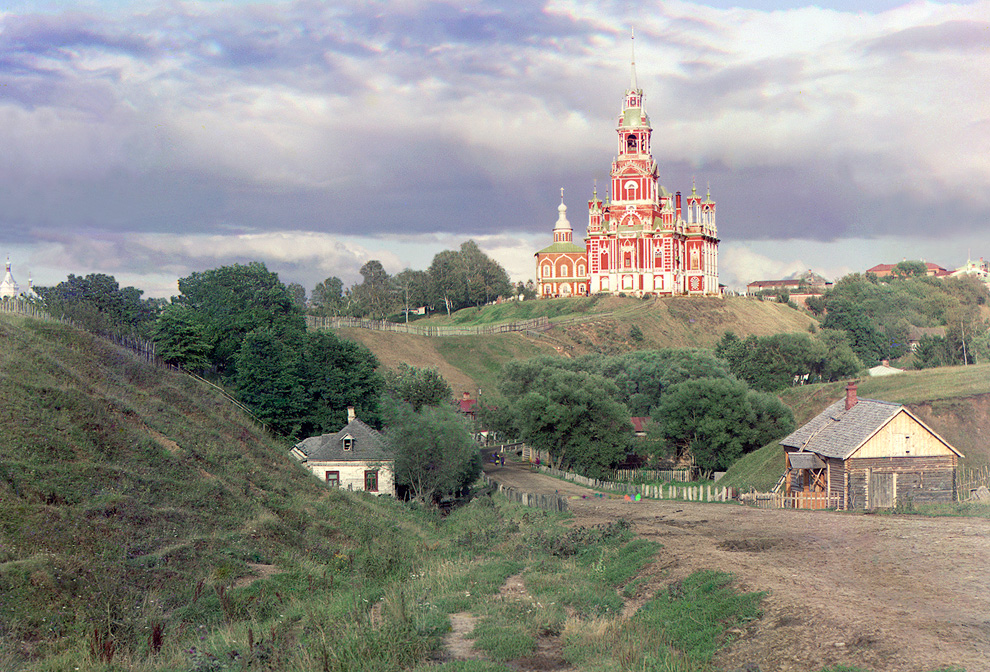
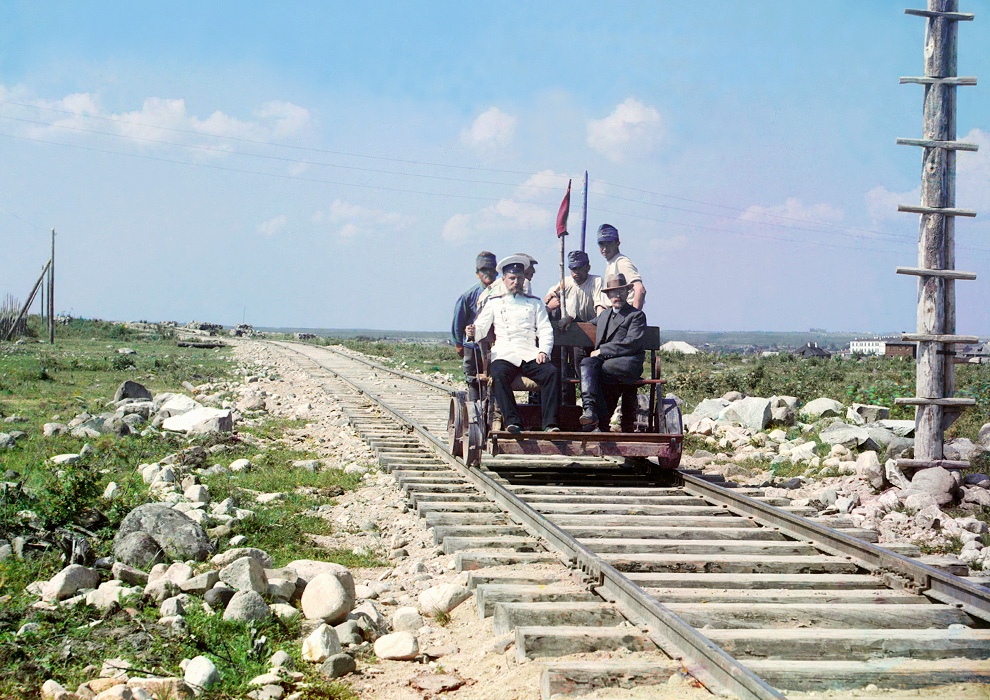
Since starting Doctor Zhivago again, Russia has been crackling in my mind. I remembered encountering some amazing color photographs of the more rural parts of the country, taken circa 191o. After a little digging around I found them again.

Take a look.

What’s amazing to me about these images is how much the presence of color seems to add to the reality of the place. I didn’t even know the world came in color a hundred years ago.

Some of these pictures look like they could have been taken yesterday. You can feel the coolness of the air. You can smell the approach of rain.

These photos are taken just a few years before the main events of Pasternak’s novel. Looking at them made me realize how dreamlike setting tends to be in my own head when I read novels; I see the image the author describes, but unless I’ve been there myself the detail depends largely upon the specificity of the author’s description. I also don’t always see much beyond that image. It’s a kind of tunnel vision of the imagination, I suppose: the scene in question stands out in clarity against a more impressionist background provided by my own imagination.

I’ve seen pictures of this era in Russia’s history before though. But not in color. And the color was what reinvigorated them for me. They took that time out of the realm of the imaginary — and black and white, because it is different from the way I physically apprehend the world, always retains a hint of the dream to me — and deposited it directly in the realm of the real. I could feel the weight of that young Khan’s coat. I could feel it’s ill fit, the prickliness of it in the heat. The despondent look on his face, the profound boredom and discomfort — I understand it more viscerally.

All of which made me think about how I imagine my own world when I write. Most of my stories are set in the present, in places I know intimately, like New Orleans or Asheville or parts of Florida. But I’m writing about Mars right now — what’s more, Mars circa 1930. It’s easy to succumb to the desire to paint a dreamlike atmosphere, or a romanticized one, like the cover of an old pulp magazine. To a certain degree, that’s even appropriate. But it’s important to remember — whether you’re writing about Mars or 14th Century France or Middle Earth — the small details that ground a fantastical setting with enough mundane detail to give it real weight, real life. A soldier whose helmet is ill-fitting or whose armor bakes him in the sun; sand and grit in the clothing; the faint stink of a sewage recycling unit that always leaks into one particular corridor of a spaceship. You can probably think of better ones.

These photographs reminded me that however distant or foreign a place seems, whether you’re reading about it or creating it whole cloth in your mind, the people who lived there often found it as ordinary and as mundane and as unromantic as we find ours. Realizing those details goes a long way toward making the fantastic seem believable.

Now, back to Mars, so I can put sand in all my characters’ shoes.

Doctor Zhivago, my old friend

This is the new edition of Boris Pasternak’s Doctor Zhivago, translated by Richard Pevear and Larissa Volokhonsky, and given to me by my dear friend A for my birthday.  It’s kind of absurd how happy this makes me. I haven’t read this book since I was a sophomore in college, and it’s quite possible that it stands taller in my memory than perhaps is really warranted. I’ll find out soon enough. But it lit up my heart back then.  I was learning Russian and I was in love with everything about the country. I loved the sound of its language, I loved its frosty mythology, I loved the way it exalted its great writers like perhaps no other country on earth. I had a book called A Day in the Life of the Soviet Union (long since lost, but which I think I will order again), which I would peruse for hours on end, enchanted by everything from winterlocked shots of Red Square to the volcanic regions of Kamchatka. It was exotic, strange, and — locked behind the Iron Curtain as it was — irresistibly forbidden.

Doctor Zhivago struck just the right note for me. Romantic, tragic, political, and epic in scope, it burned in my imagination for years. I can’t think of it without hearing Rachmaninoff’s Piano Concerto Number 2, which to me will always be the sound of Russia. Perhaps if I was a better man it would be Dostoevsky or Chekhov that loomed largest in my apprehension of Russian literature — and indeed I love them both, though neither as much as Tolstoy. But it is Pasternak that gave me the greatest pleasure, and it is Pasternak I return to now with eagerness and love.

Engines of Desire by Livia Llewellyn

Livia Llewellyn is a criminally under-rated writer of horror and dark fantasy. Her stories are about as bleak and uncompromising as any I’ve read, the characters fully formed, conflicted, beautifully flawed. I read “Horses” in manuscript form years ago and was amazed by its equal portion of compassion and brutality. The end is devastating, and masterfully earned. I am looking forward to this book perhaps more than any other this year. (Except yours, of course. But you know that.)

She also happens to be one of the wittiest bloggers in our little community. She always makes me laugh. If her blog is not one of your regular stops, it should be. Can you tell I have a crush here? No? Good. I like to keep my cards close to the vest.

Laird Barron provides the introduction. As if you needed another reason. Go do the right thing.

Working on the proposal

If you look out of the window in my living room you get a good view of  the Asheville River Arts District’s industrial chic: old warehouses converted to art galleries and coffee shops, bright colors painted on decrepit buildings, graffiti-tagged freight trains rolling ponderously by. The weather here can’t decide what to do with itself. It’s trying to snow but it just can’t quite get cold enough, so it spits ice and rain and coats our cars in rinds of frost. It’s gray and cold and wet: weather I love.

I’m missing it, though. I’m deep in my notebooks, spending time on Mars.

At the moment I’m staying in a wattle and daub hut, and I’m carefully searching out chinks in the walls and sealing them with a muddy paste. Water is precious now but this task is essential. The monsoon season is long over and the sand is dry and loose. Hot winds kick up suddenly out here and continue for days on end. This is sand storm weather. They can roll in over the horizon with breathtaking speed, as big as mountain ranges. But for now the horizon is clear: the sky an ochre smear over the pink desert.

The main colony sheds light a few hundred yards away, Bentley’s Emporium and the Widow Kessler’s new restaurant glowing like Christmas trees in the early evening. One of the mechanical water witches labors by on loose treads, sand grinding in its gears. It will need servicing soon, but there are no more replacement parts. We’ll just have to make do. Somebody will think of something.

When the work here is done I’ll go down to the restaurant and sit at the counter and listen to the people talk. There are two dissolute brothers scheming quietly in a corner. There’s a retired British explorer there who likes to reminisce about the year he spent in Zanzibar. There’s a guy who plays for the Negro Leagues back home, who came here with a barnstorming team and just decided to stay. There’s a thirteen year old kid who just fell in love. And there’s the Widow Kessler, of course, with her strange secret.

I order something from the tap. I don’t have to go back to Asheville anytime soon.