Work in progress

Here are a few paragraphs from the story I’m working on now, which will probably be about novella length when it’s finished. The story is called “I Know You.” I’m not sure how I feel about it yet. The paragraph listing the items she finds in the basement is still pretty generic; I’ll have to touch that up. Also, this is a pretty subdued beginning. I might want to punch it up a bit later. Usually I like my openings to be a bit more dramatic. I’ll know how well it fits as more of the story unspools.


The first step in putting order to the detritus of a finished life is to take stock of what remains. To this end, Amanda took the key found in her husband’s pocket by the forensics team and used it to unlock the door to the basement, which was the only room in this two-story lakeside mansion she had not entered in close to fifteen years. That she had stayed out of it all this time was due to an amicable accord with her late husband: he was afforded his underground laboratory, in which he conducted the experiments for which he had been fired from the university and which served to gain him notoriety among certain fringe communities on the internet, not to mention the occasional lucrative speaking engagements for privately funded astronomical or alchemical societies; and she had her upstairs writing den, where once upon a time she had written a book of personal essays which had garnered the favor of critics and readers alike.

That he had devoted himself entirely to his work in recent years while she had long ago abandoned hers was, she thought, just the way life worked. If human beings had their life cycles, so did love, and so did passion. She rarely thought about her early, promising days as an essayist, and when she did it was without regret. Writing, finally, is a narcissistic endeavor, and she had found much beyond herself to love, and to fill her mind.

William had always been a fastidious man, in manner as well as habit, so it surprised her to discover that his laboratory was a calamitous sprawl of half-finished projects and stranded equipment. A pungent chemical stink filled the room, mixed with the rancid-butter undertones of microwaved popcorn. A low, staticy hiss rose ghostlike from some unidentified source; it sounded like air escaping into space, and filled her with an inexplicable sense of unease. Boxes and spilled packing materials were stacked in a small mountain against the east wall; one lonely spark would turn the whole basement into a bonfire. A system of work benches divided the rest of the room into sectors, though if there was an organizing principle to this division, Amanda could not detect it.

In fact, she could make very little sense out of anything she saw down here, and it made her heart quail to think of the work ahead of her.

There were bunsen burners, a Tesla coil, beakers and test tubes and solvents and solutions, jars of formaldehyde with mysterious fleshy masses resting inside them. A monstrous telescope was set up in the corner, as big around as a tree trunk; it stared upwards through a window they had specially installed years before, so that William could chart the courses of the stars from his underground hideaway. Banks of machinery covered two of the walls; she remembered the two weeks it had taken for them to be installed by the work crew; he had been flush with grant money from one of his nameless foreign benefactors.

In the back of the room was something that surprised her: a large, clear vat, big enough to hold a child or a small dog. It was filled with a green, viscous liquid. A cheap radio had been affixed to the side with large quantities of electrical tape, and a spaghetti tangle of wires unspooled from the bottom and disappeared beneath the workbench.

The low hiss came from the radio, like an unending exhalation. As she approached it sputtered, and barked a harsh burst of static; her heart spiked, and she stopped. The hiss resumed.

Tentatively, she stepped closer again. When nothing happened, she pressed her hand against the side of the vat. It was warm — a fact she found surprisingly unsettling. She pulled her hand away.

The radio coughed again, and a voice, genderless and faint, swam up through the noise and the interference, as though it had come from the deeps of chaos and noise.

“Amanda,” it said. “Woman of petals. Steeped in blood. I have wanted to meet you for a long, long time.”

 

The terrors of girlhood

Last weekend I had to drop Mia off at a friend’s house so she could work on a project for school. She was making a coral reef out of disposable items around the house, as part of a diorama representing key scenes in 20,000 Leagues Under the Sea. I was in the living room puttering around while she was getting ready. When she came around the corner, she was wearing lipstick.

I could tell she was a little self-conscious, a little proud, a little unsure. She very studiously said nothing about it, and I didn’t either. She just started gathering her things, talking about the scene in the book they were focusing on that day. The lipstick was a little dark, and I think there was a little too much. I noticed she had applied a little glitter around her eyes, too.

It’s not like this was the first time I’d encountered this. She’s ten, she’s been curious about makeup and the various accoutrements of girlhood for quite some time. Sometimes she would disappear in the bathroom for twenty minutes or more and come out in garish colors. It’s fine, because it’s experimentation, and it’s at home. The rules are no makeup at school, and that has always worked out well.

But this felt different. I think it was just her shy demeanor, the eyes that wouldn’t meet mine, the pride and fear and hope that I could see flowing across her face. At some point it had stopped being about pretending to be a big girl. It had become about actually being one.

I’m a single dad; I guess you already know that. Common wisdom tells me I should be worried about the big things coming down the pike with a preadolescent daughter. Periods, hormones, the inevitable anxieties about sex and drinking and drugs. But you know, that stuff doesn’t worry me too much. That’s biology and that’s parenting. I can do that. I have no qualms about that stuff (he said, naively).

What worries me are these smaller details. Teaching her how to put on makeup. Dressing her properly. Doing her hair so it looks pretty. The small things of girlhood that I have no experience with. When she was smaller it mattered less; now it’s becoming important and I am very conscious of my limitations here.

She is not without women in her life. My best friend A lives across the hall and is always free with her time and her advice. Mia’s mother is a regular and influential presence. My own mother lives close by as well.

But still. When you come down to it —  on a practical, daily basis — it’s just me and her.

I need someone to give me lessons. To teach me the mysteries of blush and lip gloss and eyeliner, to teach me how to braid hair. To teach me the small details of girlhood, so that I can at least guide her or offer some helpful advice when she rounds a corner and stands shyly at the threshold of her new life, wearing too much lipstick and too much glitter around the eyes, hoping for my approval, while I just stand there, humbled into silence.

A word about what’s coming

I have four stories appearing this year, three of which are originals.

Teeth, edited by Ellen Datlow and Terri Windling, is coming in early April. My story is “Sunbleached,”about which I’ve already written, so I won’t go on about it anymore here.

Of the next two, I don’t know which will appear first. But as of today I’m able to announce that “Wild Acre” will be appearing in Visions Fading Fast, the first volume of a two-part anthology of novellas edited by Gary McMahon. It’ll come out sometime this summer.

“Wild Acre” was written a couple of years ago, but I had a devil of a time finding a home for it. I think it might be my best story, but then again writers are often the worst judges of their own work, so who knows. In the barest sense, it’s about a man who survives an attack by a werewolf. (This story and “Sunbleached” are the only times I can think of I used traditional horror tropes in any of my stories, and I have to say I’m pretty pleased with the results. Maybe I should write about a mummy next.) It doesn’t behave the way people usually expect a werewolf story to behave, which may have worked against it when it was on the market. In any case, it’s finally going to see the light of day, and I couldn’t be happier.

Next is “The Way Station,” coming this July in Naked City: Tales of Urban Fantasy, also edited by Ellen Datlow.

I think I can safely say that the people who pick up this book on the basis of the cover alone are going to be mystified by “The Way Station.” It’s about Beltrane, a homeless man who leaves New Orleans after Hurricane Katrina and goes to St. Petersburg, looking for his estranged daughter. This search is complicated by the fact that he is physically haunted by New Orleans, which manifests in his body and tends to blur the lines of reality for him. The character is loosely based on Sunbeam, a regular at the Avenue Pub, who would get free drinks and tell stories about how he used to wrestle bears in Mississippi for money when he was a young man. I’ll be writing about him directly in one of these posts, before long. I’m pretty fond of this story.

Finally, the reprint: “The Monsters of Heaven,” which won the Shirley Jackson Award a few years ago, will be appearing in Creatures: Thirty Years of Monsters, edited by John Langan and Paul Tremblay.

A few years ago I was invited by my friend Dale Bailey to go to his Oscar party, which was really just an informal gathering at his home. In attendance would be Kelly Link, Gavin Grant, and Karen Joy Fowler. Kelly, I believe, was writer-in-residence at the university where Dale teaches. I wasn’t going to go, because I was pretty sure I’d be nervous and out of place. Another friend, the far-more-pragmatic-than-I Pam Noles, basically told me I was an idiot if I didn’t go. I knew she was right, so I did. Of course I had a great time, because that’s a collection of some of the nicest people on the planet. But a side benefit was Kelly telling me that Ellen Datlow was putting together this anthology of original horror fiction, and perhaps I should contact her. I did the next day, and a year or so later “The Monsters of Heaven” appeared in Inferno, and I got my first award (“first,” he said, optimistically). So thanks, Kelly.

I remember the night I was kicking this one around. It was in the Avenue Pub, and I was talking to Neal. I had a few of the core ideas, but I didn’t know how they would fit together. I told Neal I wanted to close the story with the protagonist having a vision of his son’s dead body, and that this would be presented as a moment of release for him. It would free him. It would be a good thing, though of course the reader would recognize it’s sadness. Neal said he didn’t think it could be done. So then I had to do it, just to prove to him that I could.

(And a bonus for me: the cover art looks like it could have been taken directly from the story. Of course it wasn’t, but allow me my little fantasy.)

I’m glad to see this one still has life. The anthology comes out in November.

And that’s everything I have in the pipeline. I’m finishing two more right now: “I Know You” and “Worms in Love.” I hope to have news of their fates in the near future.

A New Orleans memory: Pterodactyls

The Tavern, where strippers and cabbies go for their 4 am constitutionals

Across the street and about a block down from The Avenue Pub is a twenty-four hour diner called The St. Charles Tavern. This is where I worked for the first six months or so after my return to New Orleans from New York, before moving to the Avenue Pub. It is, in every sense of the word, a dive. The food was ordinary, the bar sparsely stocked, and cleanliness, like most places in New Orleans, was not of paramount concern.

Nevertheless, for the locals it is one of the most beloved locations in the Lower Garden District, and deservedly so. The staff is eclectic and friendly and suffused with that affable variety of shiftlessness unique to New Orleans, and when you’re drunk in the middle of the night and need some chili cheese fries stat, there is really no better place to go.

I worked the graveyard shift when I was there. I’d get in at 11 pm and leave at 7 am. After work Ed and I would walk down the street a little ways to The Audubon, a scary, industrial-themed little bar with a grungy hotel overhead, where you could rent out rooms by the week (I spent a summer there; more on that some other time). All the kids who’d been riding high on X and acid all night would be draped over couches like Dali timepieces when we got there. We’d have a couple screwdrivers, get nice and toasted, and head home in the early morning sunlight to go to sleep.

New Orleans is the only city I’ve ever known that has a true twenty-four hour cycle. (NYC, the City That Never Sleeps? My ass.) We’d have a regular dead of night crowd. A lot of them were waiters or bartenders from other places; we got a ton of business from United Cab, which was located right around the corner; we got the strippers coming off their shifts in the deep morning, and cops, and prostitutes, and tweakers. Standard midnight crowd in New Orleans.

One of my favorites was this ancient black man named June. He was short, always impeccably dressed, and he wore a hat I’ve always heard called the Gatsby Golfer. He didn’t have any teeth, so he was sometimes difficult to understand, and when he spoke he articulated with his hands as though he were casting spells; he would sort of wave his fingers at you like anemones. I don’t think he had any idea he was doing it. So he’d come in pretty regularly, drink a few Scotches and milk at the bar, and head on home after a few. He was quiet and sweet, and he liked to talk to me and Ed. We liked it too.

We had another guy who came in for a little while. He was homeless, always broke. Old man. He’d come in and ask for coffee, and we always gave it to him even though he didn’t have any money. Normally he’d get it in a styrofoam cup, go to one of the tables and grab a sugar dispenser — one of those big glass ones that will last you through a busy dinner shift — and literally dump over half of its contents into the cup, until his coffee turned thick as river mud. Then he’d amble out into the street to attend to his mysterious obligations.

Except on the nights when he didn’t. Then he’d drink that sludge right there at a table and within three minutes he was talking and he would not shut up. Obviously this was the sugar at work. But he would keep up this steady monologue and he would not pause to take a breath. It was like Al Hirt playing “Flight of the Bumblebee.” Uncanny.

“You ever been to Los Angeles?” he would ask. No one troubled to answer because he didn’t really give a damn if you had or not. He had a warning to deliver. “You got to watch out if you go to Los Angeles because they got pterodactyls.”

Ed would cackle. Ed was the cheeriest guy I’ve ever known, and he adored this exchange. Every time. “WHAT?”

“Oh yeah man, big pterodactyls rip off your goddamned head.”

He would go on and on in this vein for quite some time. I heard it so many times that I came to believe him. I will never go to Los Angeles because I don’t want a pterodactyl to rip off my goddamned head.

Usually this guy came when the place was empty, or when the other people there were just as crazy, so I never worried about it bothering anybody. We would ask him to stop talking, but we might has well have been asking a bowl of cereal, for all the attention he paid us. We’d asked him to go, but he ignored us, and we never enforced it. I had kind of a reputation there as the guy who loved to throw people out — and oh, I deserved it, because I did love it so — but this guy was harmless. He just wanted to drink his coffee and help people out with some good advice about dinosaurs.

But one night June was there too. There might have been a few other people, I don’t know. So this guy got his coffee and pulled out a chair and prepared it the way he liked it. June was at the bar with his back to him. The guy sucked down some of the sludge and within moments he was off about the pterodactyls.

After a few minutes of this, June kind of looked over his shoulder at him. June was always stoic; the only way you’d know if he was feeling strongly about something is if he’d widen his eyes just a fraction when he was talking to you, or if his fingers reached a little closer to you when he was gesticulating. He looked at me and his eyelids lifted just a hair. I shrugged my shoulders.

Then he got off his bar stool and sat down at the table next to the man. The man got quiet. Understand me when I tell you that that had never happened before. I didn’t even think it was biologically possible. June leaned in and whispered something. The fingers of his right hand were waving like fronds under the sea.

The man seemed to think a moment. Then he got up, took his coffee cup, and left the building. In utter silence. We didn’t see him for a week afterwards.

Ed and I were agog.

“June!” I said, when he resumed his place at the bar. “I can’t believe it! What did you say to that guy?”

He inclined his head a little, his eyes fixed on his Scotch and milk, which he started to stir. “Oh, you know,” he said, “I just said a little something to him.” Then he looked at me, and the fingers of his right hand reached out, clasped, and drew back, like he was pulling something invisible out of me. “One of these days I might say a little something to you.”

I was genuinely unsettled. “Um, please don’t,” I said.

And that was that. A few months later I was snagged by the Avenue Pub, and shortly thereafter I convinced them to hire Ed, too. June came down to visit us once or twice, but The Avenue was not the Tavern. It just wasn’t his place. He went back to his old haunt.

After a while, we just stopped hearing about him.

My daughter’s political awakening

This morning, while I was driving Mia to school, I tuned the radio to the liberal talk station. Bill Press was coming on, and was leading his program with the protests in Wisconsin. I used to listen to this station all the time, but stopped as I began to grow tired of the lack of nuance displayed in the arguments. (My politics are deeply liberal, for fundamentally ethical and moral reasons, but it drives me crazy when people of my own side argue poorly, or dishonestly — which often happens when people are arguing about Team Democrat or Team Republican, instead of the moral engines that drive political philosophy.)

Anyway. The liberal station was on. I couldn’t listen to Ke$ha one more goddamned morning. (The breaking point: Mia turning to me and asking, with the frank and innocent curiosity of a girl of 10, “Dad, what does ‘grow a pair’ mean?”) Press was interviewing the president of the Sheet Metal Workers International Association. Mia was silent for much of the drive. I could tell she was listening, but I knew much of it was going over her head.

Finally I turned down the radio.

“What’s going on here, kiddo, is –”

“I know, Dad. It’s about the governor of Wisconsin trying to stop people from being in unions.”

“Well … kind of.” There was no way she gleaned that from what she’d just heard. “Are they talking about this in school?”

It turns out that her teacher presents them with “political points,” which I take it are little kernels of topical news, and have the students think about them. I was impressed. I asked her what she had been taught, and she had a hard time verbalizing it. Which is understandable; it’s a complex idea for a fifth grader to understand. Hell, it is for many adults.

I tried to give her a more layered understanding of it, explaining what collective bargaining was (briefly), and talking a little bit about unions, what they were for, and why they were important. I asked her if any of that had been covered in class, and she said they had not.

“Dad, they just assume that we know what’s going on in the world, but this is the only news we get!” She gestured at the radio.

And I realized, to my horror, that she was right. We don’t have cable at home, so our television is used for watching DVDs and not much else. I get my news from various sources online. I’m so used to thinking of her as a little girl that I tend to forget that she’s reached an age that an awareness of the larger world is not only possible, but necessary.

And then she said, “I don’t know what to do, Dad. Mom tells me not to listen to the news because it’s depressing, but other people say I should because it’s good to know what’s going on in the world.”

How had I allowed myself to be left out of that conversation? And who was having it with her? I really dropped the ball here.

I told her that I was on the side of the argument that felt it was very important to know what was going on in the world, and why. Even if it’s depressing. I was careful to point out that it wasn’t always depressing, anyway. Wisconsin was an example. If the governor had been able to force his agenda on a passive and uninformed populace, it would have been. But because those people were paying attention, because they were aware of what was happening in the world, they were fighting back. And that was anything but depressing.

I resolved this morning to subscribe to a newspaper. I don’t know that she’ll want to read it often, but I want her to see that news is important, that information is important, and that it’s a regular part of life. Watching her dad stare at a computer screen does not convey that. I might be reading The New York Times, but I could be reading Facebook, for all she knows. I think that just a physical manifestation of the news, of some record of ongoing world events, will help reinforce the idea that this matters, and that it’s important to be aware of it.

She’s a curious child, and she loves to know things. Nothing infuriates her more than thinking that someone’s not telling her something, or that someone thinks she can’t handle something. She’s just like her old man that way. So I’m pretty convinced that if she sees me reading the paper in the morning, and talking a little bit about what I find there, it won’t be long before her little fingers are reaching for it too.

What will she make of what she finds? What kind of political ethos will she develop? I’m old enough now to know that I can’t dictate that, nor should I try to. I can teach her to be a moral human being. I can let her see my own ethical framework. These are the things that inform my own political disposition. I hope it’s one she grows to share, and frankly, I believe she will. But the first step in getting there — or to the dark side, should she choose to go that route — is knowing what’s happening outside our front door.

The Cannibal Priests of New England, part three

III. The Cargo

The sailors called him William the Bloody, because it made them laugh. William Thickett was a small, slender man: stooped, balding, and constantly ill. He had a penchant for nosebleeds — they came without warning, and always with a gruesome vigor — and so he received his name. He was born thirty-seven years ago in the Commonwealth of Massachusetts but fled to the islands after escaping one of the Farms in Boston. He kept a gun beneath his bed, and he slept poorly.

He had come into possession of a small, ramshackle warehouse, situated far from the docks, in a game of cards three years ago. He stored unmarked cargo for indefinite periods without asking any questions, and he provided sails and timber to the quartermasters who came to him when it was time to refit their vessels. As long as he did these things he was assured a livelihood here.

Even so, he knew that the time to leave was almost upon him.

Rumors and whispers grew like mold in this dank little town, and he was beginning to hear words that scared him. Words like cattle hunters. Prospectors. Carrion angels. Cannibal priests.

He was alone in the warehouse. It was densely packed with mildewed crates, rolled canvas, bags of grain. A single lantern, balanced precariously on a wooden barrel full of God only knew what, cast a shallow little nimbus of orange light, and threw strange, wide-shouldered shadows against the wall. A cool wind blew in from the bay, carrying the sharp tang of ozone, the promise of rain and thunder.

He wished it would start soon. In the quiet he could hear the hoarse whispers, a dozen or more voices attempting speech in the strange tongue of the dead. The voices crawled over the walls like cockroaches.

He heard a pair of boots trod over the wooden floor outside his office and he sat quietly as the door was pulled open. Captain Beverly shouldered into the small room, his first mate close behind him. The captain’s eyes danced quickly around the contents of the room before settling on him at last.

“William the Bloody,” he said. “Bless my bones.”

William nodded at him. “It’s been some time, Captain. It’s a fine thing to see you again.”

“You’ve met my first mate, Mr. Thierry?”

“I have, sir. Yes. I have the cargo right here, sir.”

Captain Beverly and Mr. Thierry exchanged a glance. “Right to business then, is it? All right, William, all right. Show it to me then.”

William the Bloody guided the two men out to the main floor of his warehouse. There was a large door here which would swing open to admit carriages drawn by mules or oxen, but it was secured fast, shutting out the din of the town. He carried the lantern in one hand to light their path. The whispering voices were louder in here; he felt steeped in ghosts.

The voices came from the crate, about waist high, which sat in the middle of the room like a diminished little temple.

“I have a carriage secured. It’ll be waiting outside,” said William. “On my expense, of course.”

“Of course, William. Always reliable.” Captain Beverly nodded at the crate. “Open it.”

” … Captain?”

“I want to be sure.”

William fetched a crowbar from a shelf and set to, his body sheened in an icy sweat. Nails squealed against wood and the top of the crate popped off. William the Bloody stared inside despite himself. He felt the pirates come up on either side of him.

The crate was filled with severed heads. Their mouths moved thickly and slowly, pushing sound through their mouths in thin, reedy little wisps. Eyes rolled in their sockets. Tongues moved like grubs in earth. The heads were blackened with decay but they appeared to be European. The language they attempted was like nothing any of them had ever heard.

Captain Beverly clapped him on the shoulder. “Seal it, William.” His demeanor was much reduced.

William gratefully complied, quickly nailing the lid back over it. The voices were barely muffled.

“There’s talk, William,” the captain said to him as he worked. “The Farmers are looking for you.”

He paused in his work. He held one long nail between his fingers. He stared at the dirt caked around the fingernails, the grain of the wood beneath his hand. He said nothing. A dark coin of blood dropped from his nose onto the crate’s lid.

“Consider this a favor, old friend,” said the captain. He felt more than saw Mr. Thierry move behind him.

“No,” said William the Bloody, and then the world opened into a terrible shard of light. It seemed, for a moment, that he heard a girl singing, and he smelled burning hair. He almost rememb–

Captain Beverly wiped William the Bloody’s brain from the crate with a handkerchief, then folded it gingerly and placed it back into his pocket. Mr. Thierry held the smoking blunderbuss at his side.

“See that this gets on board,” said the Captain. “And smartly. I want to be gone before the jackals arrive.”

Outside, it had finally started to rain.

An act of faith

Theodora Goss wrote a post called Value Yourself yesterday. It’s generating a lot of positive response, and it should. Read it now, please, if you haven’t yet.

Although her post addressed the topic in a broader sense, I’m thinking of it today chiefly in terms of writing.

I’ve alluded to last year before, but it bears repeating in this context. I didn’t write much of anything all year, and a lot of it had to do with the very problem she cites in her post. I had this core belief that nothing I was producing, or had ever produced, mattered at all. Of course I’m far from alone in this. I think most writers who grapple with those feelings at least some of the time.

And it seems that these feelings are completely independent to whatever level of success you might have achieved. My stories have all been well-received, with lots of Year’s Best reprints, praise and respect from writers I admire, and a Shirley Jackson Award. You’d think that stuff would provide some sort of buffer for the times when the doubt comes crashing in on you, but it doesn’t. I have no doubt that bestselling authors feel it too.

Last year I let the doubt become so virulent that I considered quitting writing. I let deadlines slip by. I had only one story to write to finish the manuscript for my collection, which would have provided a significant morale boost, and I didn’t even start it. It’s possible that I damaged a professional relationship or two: when you lose faith in yourself, other people can sense that, and they begin to lose it too.

All of which is to say that doubt can do far worse than slow you down. It can stop you cold. It can kill you if you let it.

I wrote a little bit about this earlier, in a post called “Talking to a writing class.” Reading Dora’s post last night, I was reminded of how I’ve come to understand, finally, that writing is an act of faith. At least, it is for me. It’s how I have to think about it. Faith that it means something, faith that it will find a reader, faith that the words flow in a graceful and meaningful way. Faith that, even when I despise every sentence appearing on the page before me, they’re better than I am prepared to recognize. Writing is as close to religious practice as I have ever been in my life.

This is a lesson I should have learned from bartending, strangely enough. Years ago, when I told a friend that I had been hired to tend a bar, she was incredulous. I was painfully introverted, and the thought of me running a neighborhood bar was a little absurd. But that was exactly why I did it. I was determined to change that about myself. So I bullshitted my way into the job, got back there, and just pretended that I belonged. I pretended to feel confident and I pretended to be witty. And because I pretended to believe it, other people did believe it.

Within a month, I wasn’t pretending anymore. It was real.

The vampire videos

Last year all the contributors to Teeth, the upcoming vampire anthology, were asked to answer two questions and record them for this promotional video. Here they are.

First question: would you want to be a vampire for a month? As usual, Jeff Ford steals the show. “If I could be a vampire of sandwiches, that would be cool.”

Second question: What attribute of a vampire would you most like to have? Holly Black: “Eternal hotness.” Well, yeah!

The book is out in April.


On Valentine’s Day

She knew, when they stepped into her little apartment, that they would eventually make love, and she found herself wondering what it would be like. She watched him move, noticed the graceful articulation of his body, the careful restraint he displayed in her living room, which was filled with fragile things. She saw the skin beneath his clothing, watched it stretch and move.

“Don’t worry,” she said, touching the place between his shoulder blades. “You won’t break nothing.”

He shook his head like he did not believe it. Her apartment was decorated with the inherited flotsam of her grandmother’s life: bland wall hangings, beaten old furniture which had played host to too many bodies spreading gracelessly into old age, and a vast and silly collection of glass figurines: leaping dolphins and sleeping dragons and such. It was all meant to be homey and reassuring, but it just reminded her of how far away she was from the life she really wanted. It seemed like a desperate construct, and she hated it very much.

Alex appeared to be more interested in Gwen, her daughter, who was peering around the corner of the living room and regarding him with a suspicious and hungry eye, who seemed to intuit that from this large alien figure on her mama’s couch would come mighty upheavals.

— You Go Where It Takes You

She plucked the picture from his hand and tossed it to the floor, laughing at him. “What the hell are you looking at?” she said, rolling her body onto his legs.

He laughed despite himself, grabbing a handful of her hair and giving it a gentle tug.

“Ain’t you mad no more?” she asked, her fingers working at the button of his pants.

“Shut up, bitch,” he said, but affectionately, and she responded as though he’d just recited a line of verse, shedding her robe and lifting herself over and onto him, so that he felt as though he were sliding into a warm sea. He closed his eyes and exhaled, feeling it down to his fingertips.

They moved roughly, urgently, breathing in the musk of each other, breathing in too the smell of the pines and the lake and the dead monster, this last growing in power until it occluded the others, until it filled his sinuses, his head, his body, until it seemed nothing existed except the smell and the awful thing that made it, until it seemed he was its source, the wellspring of all the foulness of the earth, and when he spent himself into her he thought for a wretched moment that he had somehow injected it with the possibility of new life.

She rolled off of him, saying something he couldn’t hear. He put his hands over his face, breathed through his nose. Tina rested her head on his chest, and he put his nose to her hair, filling it with something recognizable and good. They lay together for long moments, their limbs a motionless tangle, glowing like marble in the fading light.

— North American Lake Monsters

He gave up trying to subdue his fluttering heart, hoped she wouldn’t see his hands shake, wondered if she knew that he had never been with a girl before, wondered if that fact blasted from him like bright radiation.

She started to unbutton her shirt. She wore nothing underneath, and she moved her shoulders so that her blouse slid behind her to the floor; she stepped out of her jeans like a woman stepping out of water. Tattoos were inscribed all over her thin flesh; their bright colors made them luminescent in the harsh glow of the flashlights: a snake coiling over her upper right arm and looped halfway down to her elbow; a naked pixie with a devil’s face under her collarbone; a series of words — poems or mysterious lists — beginning at her pelvis and wrapping around her thighs; the crossed hammers over a Confederate flag on the slope of one breast; a black swastika, like clumsy snare of stitches, on the other. They glowed on her naked body like an incandescent language. He had once heard the phrase “illuminated manuscript,” and although he did not know what such a thing was, he thought that it must be something like Trixie’s body, which was covered with the letters of a holy alphabet, which was itself a a supple word, or a series of words, a phrase she whispered to him now and she moved his hand aside and replaced it with her own. She moved him toward his bed, and he abdicated himself to the study of her.

— S.S.

A clean and clear work space

I’m always interested to see another writer’s work space. Terri Windling, who has one of the most beautiful blogs on the web, often posts pictures of the rooms or desks of creative people. I think most writers tend to lead cluttered lives. Books and papers are piled everywhere. Some keep little tokens on their desks, or inspiring quotes stuck to the walls.

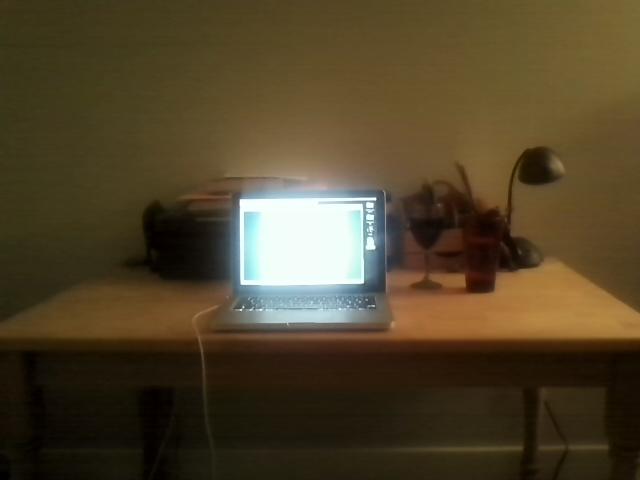
I am very much a cluttered person in my day to day life. I’ve been living in this new apartment for several months now and there are still stacks of books waiting to be organized and shelved. But my workspace is different. It’s practically Spartan. It has to be.

This ... is ... SPARTA!

I can become so easily distracted when I write it’s kind of ridiculous. All those books I’ve been meaning to read but haven’t gotten around to sing their sexy little songs to me, they do their saucy little dances. And I am but a man, after all. Even my old annotated copy of The Canterbury Tales, that great red brick of scholarship and Middle English drudgery, seems coyly enticing when I’m trying to get started on a cold story. Those DVDs I haven’t watched in years start rattling in their little plastic boxes. I apply a little logic to the situation: I’m writing a story about a mad scientist … so watching The Abominable Dr. Phibes will sort of be like research, right? Right?

So I have to clear everything away. I have to look at a blank wall, and I can’t have books or DVDs or even music in the room. (Music is actually okay when I’m revising, and can even be helpful then. Or when I’m thinking about what kind of story I’m going to be writing. “You Go Where It Takes You” was conceived while listening to Sarah McLachlan sing “Witness” over and over and over again.) Once I get rolling on a story, this becomes less important. But it’s vital when I begin.

I find that my mind feels cleaner when my environment is that way too. It’s as though absorbing the fact of too many things in a room takes up a degree of necessary energy. When it’s gone, I can devote it all to the task at hand. I think I could live quite comfortably in a small shack with full bookcases, a bed, and a simple kitchen.

I would just have to write with my back to the books. Like I’m doing right now.