A brief return to the city

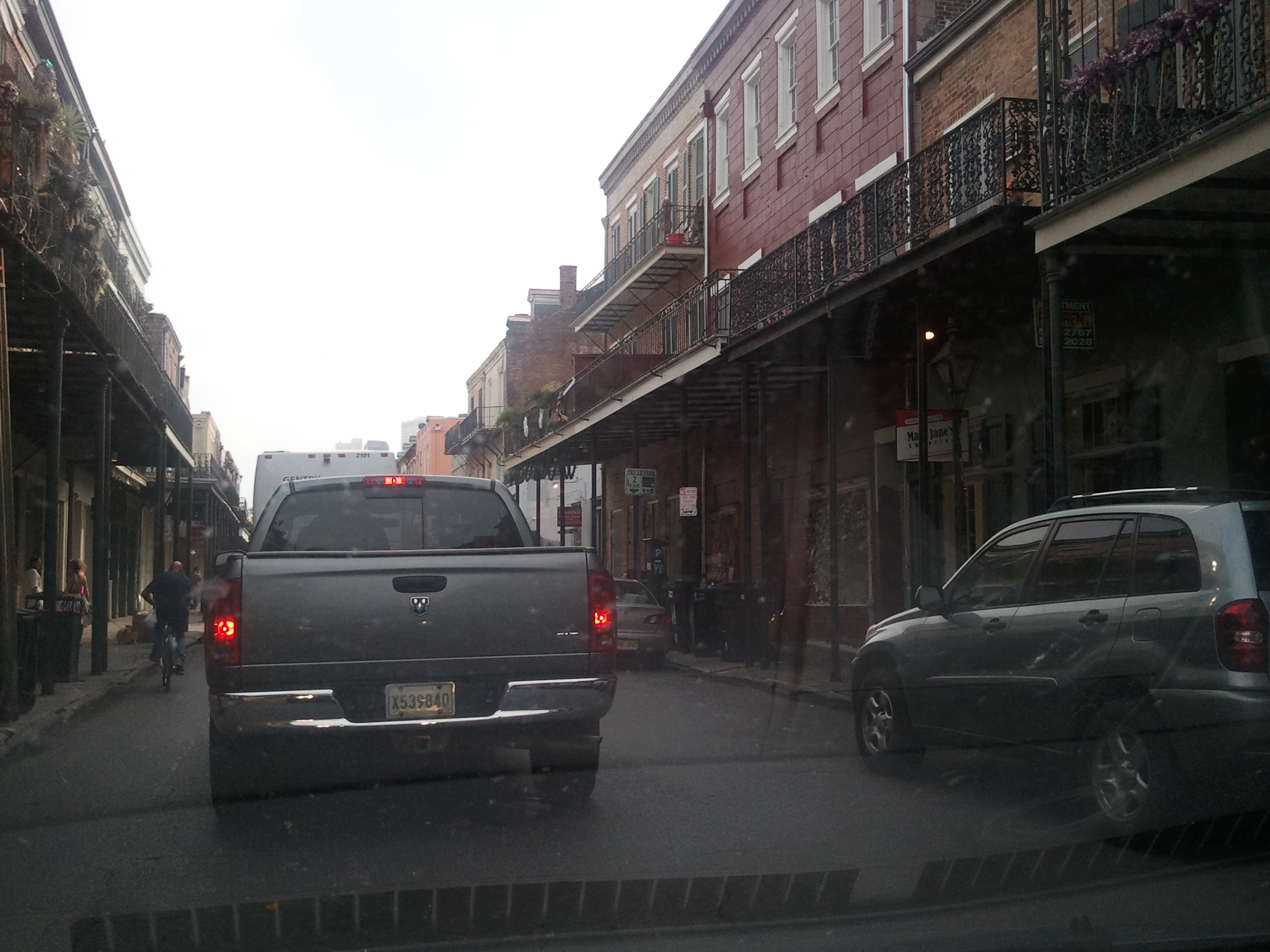
This past weekend I went back to New Orleans for the first time in over five years. When I passed through Mobile and hit the I-10 going west, the landscape flattened, the air and the light changed. I could feel the nearness of the Gulf in my blood, and the nearness of my city.

Approaching New Orleans again

I was there to attend a wedding, and therefore my time in the city would not be my own. I did not have the chance to steep myself into it the way I would have liked. It will take me a little time to decide how I felt about being back there, and how I felt about the changes.

I went back to the Avenue Pub and it was like walking into a new place altogether. It’s mostly a beer bar now, catering to an upscale crowd. On the first day of my visit they had scheduled a bourbon tasting for later in the evening. In my day a bourbon tasting would have consisted of a lined row of shots of Jim Beam. I saw a few familiar faces — Vickie, Beth, Eileen, and Karn — but otherwise it was a new place, with new people. That bar was my world, once. I owned it, and it owned me. Now I felt like a stranger.

I was received coolly by the new owner, who takes a dim view of the Pub’s earlier, grungier incarnation. Beth, who was a regular when I worked there but has since been hired as a bartender, introduced me to one of the new bartenders on duty, and told her I used to work there. This new bartender asked me what I’d like, without making eye contact. I told her I’d take a Guinness.

“We don’t have that anymore,” Beth said, apologetically.

“What?”

“You can get that at any bar, so we don’t carry it now.”

Oh. Beth recommended another stout, which I tried and thought was all right. As the new bartender (whose name I can’t remember) placed it in front of me, I made some half-assed comment about how the place looked very clean. Trying to be friendly.

“Yeah, it’s really gone downhill,” she said. Still not deigning to look at me.

“Just the opposite,” I said.

“I was being sarcastic.”

“Yeah. So was I.”

I spent the next few days trying, when I could, to find my home again. I saw glimpses of it. There were times I felt the city open to me, and welcome me. And there were times I wondered if she had turned her back on me forever.

I’ll need a return visit. I’ll need more time. I’ll need to look with more care, and more thoroughness, to see if she remembers me. To see if she’ll still show me her secret face.

The Cannibal Priests of New England, part four

IV. The Darling of the Abbatoir

Alone in the first mate’s quarters, which had been surrendered to him without a twitch of protest by the one-eyed Mr. Johns at his captain’s order, Martin Dunwood lay in the cot suspended crossways across the tiny little room and tried to acclimate himself to the deep pitch and tumble of The Lady Celeste as it pushed its way across the cresting waves, on its way to the open sea. Somewhere above him rain drummed over the ship, and its crew worked the lines and the sails with the precision — or lack of it — one might expect from a congress of pirates. Martin did not care to speculate on their abilities; he felt sick enough already. Instead he entrusted his fate to God and focused his attentions on better things.

Alice.

The promise of Alice pulled him across the sea, from his meager home in St. Giles to the polluted stink of London, and then to Tortuga and this wicked man’s vessel; he resolved that he would let it pull him across the whole world before he would ever give up his search.

The light in the lantern guttered as the ship plummeted down a steep trough. Martin snuffed it out before it could spill and light the room on fire. The darkness which fell over him was oppressive, as though someone had thrown a weight over him. The sounds of the water smashing into the hull, and of the raw voices outside shouting to be heard over the storm, became impossible to ignore. It seemed as though the whole ship’s complement had suddenly crowded into his cabin and begun knocking things about.

So he thought of Alice.

He remembered the first time he ever laid eyes on her: she had been standing on a corner outside a grocer’s shop. Her fine clothes and her red hair were disheveled and there was a horror in her expression, her face as pale as a daylight moon. Blood matted the expensive materials of her dress, caked heavily near the lower hem and arrayed in a pattern of sprays and constellations further up her body, as though she had just waded through some dreadful carnage.

Martin, who had been sent to London on his father’s errand the previous day, stood transfixed. He didn’t know what catastrophe had befallen her but it seemed she needed immediate help. He waited for a carriage to pass before he stepped out into the muddy thoroughfare, but immediately came up short — an older gentleman stepped out of the grocer and joined her at the corner. He too was well-dressed, though his clothes were free of blood. He threw an overcoat around her shoulders and hailed a carriage. Within moments he bundled her into it, and with a flick of the driver’s wrist she was whisked away, leaving behind her an ordinary corner on an ordinary street. The drabness of the image seemed to reject the possibility that she had ever been there.

It was not until years later that he saw her again. By that time his father had accrued some money through real estate, and had graduated into more elevated social planes. They had been invited to a party thrown by a local banker, and as Martin lurked unhappily in a corner of the room, resenting the pomp and self-satisfaction of the people around him, he saw her again.

She was standing amidst a crowd of men, young and eager for her attention. She smiled at one of them as he gestured to illustrate some point, and Martin knew at once that none of the fools had a chance with her, that she was wearing them like jewelry. He pressed his way through the crowd until he joined her little retinue.

If she noticed him as he approached she did not show it. He stationed himself in her outer orbit and just watched her. She stood stone still, and although she was properly demure and maintained the comportment of a young lady of her station, she was set apart from everyone around her. She seemed carved from stone. She was acting.

At the first break in the conversation, he said, “Didn’t I see you once outside a small grocer’s in the East End? It would have been a long time ago.”

Her eyes settled on him. They were a pale blue. “I rather doubt it.”

“You would remember this,” he said. “You were covered in blood.”

She betrayed no reaction, but even in that she revealed herself. No shock, no disgust, no laughing dismay. Just a cool appraisal, and silence.

One of the young men turned on him, his blond hair pulled back harshly from his forehead in a bow. “I say, are you mad?”

“Possibly,” said Martin.

“It’s all right, Francis,” she said. “He’s right. I do remember that day. It was quite dreadful. A horse had come up lame and had to be shot. It was done right in front of me and I think it’s the worst thing I ever saw.”

“I don’t remember a dead horse,” Martin said.

“Perhaps you weren’t paying attention,” she said. “So much goes on right under our noses.”

Within minutes she had dismissed her pretty men and Martin found himself sitting some distance from the party, talking to this remarkable woman who seemed to fit amongst these people the same way a shark fits amongst a school of mackerel.

“Why did you say that to me?” she said. “What did you think would happen?”

“I had no idea. I wanted to find out.”

“Hardly the right environment for radical social experiments, wouldn’t you say?”

“I would say it’s precisely the right environment.”

She offered a half smile. “What’s your name?”

“I’m Martin Dunwood. My father owns the–”

“Are you some sort of anarchist, Martin Dunwood?”

“Would it make me more interesting if I said yes?”

In minutes they were in the banker’s bedroom, fucking with a furious, urgent silence. Thereafter they met often, and always clandestinely. She was even more contemptuous of the world than he, prone to stormy rages, and he got drunk off of that rage. It was wild and different and echoed his own sense of alienation from the world. Their illicit sex was as much an act of defiance as it was a hunger for each other. After a month of this she took him to his first Farm, and he saw what she did there.

It was when he watched the blood drip from the ends of her long red hair that he knew he was in love with her, and that he would break the world to keep her.
A corrective to the previous post

I’m feeling a little guilty about inflicting the clowns on you. So as a corrective — and keeping in line with the theme of miracles — here’s Roger Waters singing “It’s a Miracle,” from the album Amused to Death.

This is my favorite song on the record. It’s sad and angry and beautiful.

We cower in our shelters
With our hands over our ears
Lloyd-Webber’s awful stuff
Runs for years and years and years
An earthquake hits the theater
But the operetta lingers
Then the piano lid comes down
And breaks his fucking fingers.
It’s a miracle.

“Long neck giraffes, and pet cats and dogs … I seen shit that’ll shock ya eyelids!”

The update to the Cannibal Priests will be delayed a little bit longer, as I have a deadline in three days and all else must wait. In the meantime, because I love you, I’m going to leave you with some heavy shit to meditate on.

“We don’t have to be high to look in the sky
And know that’s a miracle opened wide
Look at the mountains, trees, the seven seas
And everything chilling underwater, please
Hot lava, snow, rain and fog
Long neck giraffes, and pet cats and dogs
And I’ve seen eighty-five thousand people
All in one room, together as equals
Pure magic is the birth of my kids
I’ve seen shit that’ll shock your eyelids
The sun and the moon, and even Mars
The Milky Way and fucking shooting stars!”

And my favorite:

“Fuckin rainbows, after it rains, there’s enough miracles here to blow ya brains!”

Bring the wisdom, crazy clowns!

The week that was

1. We’re going through a mild cold snap here in North Carolina, one of the last before Spring settles in for good. I’m going to miss winter, though I know I’m alone in that.

Goodbye, winter. Nobody understands you but me.

2. Mia rewrote Rihanna’s “Only Girl in the World” last night. It’s new title is, “Only Girl in the World (spoofed into a milkshake).” These are the lyrics:

Ma ma ma malt ma ma ma malt

ma ma ma malt yeah ma ma ma malt

I need to give my tummy something chocolately

mm yum

I want to drink something smooth and sweet

Forget the veggietables cuz I need to have a treat

I don’t want to eat

I don’t care about the calories.

chorus:

I want to have something besides a bottle of Coke

Stuff like smoothies they’re a joke

I don’t care about my diet right now besides a bottle of Coke

I have I have the money don’t worry I’ll brush my teeth

I’m hungry but not enough to eat

No diabetes

No I’m not gonna get sick please Dad I don’t want to fight

Smooth creamy goodness with whip and a cherry to make it nice

Large medium small I don’t care about the size …

She performed it and it was kick-ass. I immediately introduced her to Weird Al Yankovic, so she could see the proud tradition she is working in.

http://www.youtube.com/watch?v=BVVc_aMDzP0

3. I started reading Ninety-Two in the Shade, by Thomas McGuane. I’ve never read him before and the jury is still out on this one. The prose is cooked over a high heat, which produces mixed results. On the one hand, there are infuriating sentences like this one:

“That’s right,” Skelton said positively to this basilisk drunk.

I like “basilisk drunk,” but the word “positively” is just the kind of thing that gets produced in the fury of the moment and ought to be caught in editing. Because now it’s a stupid sentence. On the other hand, you have amazing paragraphs like this one:

“Then, a fifty-seven-day bad marriage to a Catholic from Chokoloskee that ended in the court reconciling everything he had acquired but a skiff and it all went off in a Bekins moving van with the wife up front by the driver, headed for the Everglades. And drinking of the kind that is a throwing of yourself against the threshold of suicide though lacking that final will to your own ceasing, without which all the hemlock and Colt’s patented revolvers are of no more avail than ringside tickets, photostats of lost deeds, or snapshots of Granddad’s five-bottom plow.”

4. It is past time to update “The Cannibal Priests of New England.” This weekend.

The slow suicide of the world

“And the answer, said the judge. If God meant to interfere in the degeneracy of mankind would he not have done so by now? Wolves cull themselves, man. What other creature could? And is the race of man not more predacious yet? The way of the world is to bloom and to flower and die but in the affairs of men there is no waning and the noon of his expression signals the onset of night. His spirit is exhausted at the peak of its achievement. His meridian is at once his darkening and the evening of his day. He loves games? Let him play for stakes. This you see here, these ruins wondered at by tribes of savages, do you not think that this will be again? Aye. And again. With other people, with other sons.”

— Cormac McCarthy, Blood Meridian

Yesterday Mia came home with an assignment. She had to Google the phrase “the most shocking plastic pollution you’ve ever seen” and watch the video it lead to.

When she saw the part where the seagull gulps down an enormous plastic bag — literally swallowing its own death — she looked at me. Not with accusation, or confusion, or fear; just with this kind of wounded awareness. It’s as though she wanted to share an acknowledgement that we had seen something awful, something that couldn’t be changed or undone. The scale of the damage is beyond belief.

I don’t believe that we’re going to fix what we’ve done to ourselves. I don’t believe we have the means or the will. The relationship we have with the world is entirely parasitic. We’re going to eat it until we all die.

But it’s hard to reconcile our collective guilt with my daughter’s glance. She is not guilty. Not for the world she was born into, nor the habits and behaviors she was trained to repeat. If we as a species are a cancer then I have to wonder if the individual cancer cell can be innocent.

I say yes.

Sometimes I’ll go outside at night and look into the stars. I think all the usual thoughts: how vast it all is, how much might be out there. How insignificant our place. And it’s that last thought that gives me the greatest sense of peace. It makes me happy that no matter what we do to ourselves here, there might yet be clean places in the universe; whole worlds free of the human infection.

A ghost is a hole in the mind

Edward Hopper, "Sun in an Empty Room"

Sometimes you only know a ghost by what you don’t see.

“You remember that house on Lincoln Avenue?”

This was pretty soon after I moved back to Asheville from New Orleans. I had come back here as a matter of necessity, not of choice. The city felt small and cramped to me after so many years away. Moving back here was like trying to wear a coat I’d grown out of: sleeves too high on the wrist, shoulders too tight. It made me feel awkward and ridiculous.

But on that afternoon I was having coffee with my brother. We’d become estranged over the preceding years, and I found in him a surprising familiarity. It amazed me how many of my own strange quirks were reflected in him. Hanging out with him was like spending time with a less wrecked version of myself, and it was both comforting and encouraging.

“Sure,” I said. The house he was referring to was the one we’d lived in during most of my teenage years; it was where I was living when I went to Asheville High and found my heart attached to Karen but somehow ended up dating Barbara. When I played trumpet all the time and wrote a lot of really bad comedy stories. (There was a time I thought I was destined to be a funny writer.) Most of my memories from that time centered on my time outside of the house, in my high school life. I guess that’s true for most teenagers.

“Do you remember that it was haunted?”

I smiled. “No,” I said. “Not at all.”

“Seriously?”

“You know I don’t believe in ghosts.”

He was incredulous. “You don’t remember how Mom never slept up there? She always slept on the couch. And the dogs refused to go up there. If you tried to lead Seneca up the stairs she would drag you back down. How can you not remember that?”

It was late afternoon at this point. We were sitting in a booth and the sun was coming through a plate glass window, hard and bright. I was on my second cup of coffee and my blood was jangling. It was maybe the least conducive atmosphere for a discussion of ghosts I have ever found myself in. Which made what he had just told me seem all the more ridiculous. Especially when you considered one crucial fact:

“Jess, there was no second floor in that house.”

He just stared at me for a second. He went on to describe the second floor. One large room, with decorative molding running near the floor and small blue flowers painted there. Hardwood floors, windows which filled the room with light. It gave every appearance of being a cheery place. But something in there rejected human presence.

I thought about the layout of the house: retraced steps, remembered sitting in my room talking on the phone with the window open and cool air coming through. I remembered the unfinished basement, which actually did seem sinister to me, and a logical place for a haunting if there was to be one. But I could not remember an upper room at all. I could not remember a door which would open onto a stairwell. I did not believe it.

I needed proof, so we got into the car and drove by the old place. I slowed down as we passed it and looked. It was painted yellow, and the front porch had been screened in since we’d lived there. And there was a window near the top, covered by curtains, though the sun had not yet set. A second floor. I let the car idle and stared.

Nothing came back. Nothing at all. It seemed impossible to me. And yet there was that window, incontrovertible, and behind it a hole in my memory as absolute as if nothing had ever been there at all.

We toyed briefly with the idea of knocking on the door and telling the story to whoever lived there now, hoping they would let me see it, but for some reason we decided against it. We drove away.

My brother and I have become estranged again, since that time. It amazes me that we can be so alike in some ways — sharing personality traits and perspectives that I’ve not found in anyone else in the world — and yet have differences so vast that they sometimes seem uncrossable.

We make narratives of our lives. We cast the people around us in roles, and learn to see them that way, even if it means distorting who they really are. We remember events or forget them in a way that will make our chosen narrative true. The stories we tell ourselves about ourselves can kill us if we’re not careful.

My brother’s role has shifted several times over the years, and may do so again.

I don’t know why I felt the need to forget the upstairs room. Why, even now, the image I have of it is the one described to me, and nothing I can draw from memory.

It doesn’t matter. Because there are no ghosts in my story.

Only empty spaces.

The secret dream of Laird Barron

The sea was high and gray and spat foam. The boat pitched and yawed over the waves. The small crew stayed indoors as much as possible; the weather was turning cruel and the temperature was falling. For days now the nets had brought sparse hauls, and the prospect of going home light hovered over them all like an evil fog.

They were at mess, clutching hot mugs of coffee and keeping them balanced in the rough waters with the practiced grace of men who are often at sea. Netting was strung over the shelves to keep the kitchen supplies from clattering all over the floor. Talk was muted and grudging.

“We need to head back home,” one of them finally said.

A few glances came his way; some of the men wanted to protest but the spirit was leaving them. Each man got a cut of what they brought back, and with so little to show, they would be making a lot less than they’d counted on. Still, they were pushing their luck out here, and they’d been gone a week longer than they had planned. Nobody had the taste for it anymore.

Laird pushed himself away from the table and stowed his mug. “I need some air,” he said.

The fishing boat cast fountains of spray as it pushed through the sea; it’s seine nets were spooled in the drum at the ship’s aft, and Laird maneuvered around them, until he stood watching the vessel’s foamy wake. A boil of grey clouds covered the sky and seemed to fall all the way to the water.

The mood inside was bad, and it would be worse when they got home. Poverty bred fear, which bred anger. Blood rode so close to the surface of the skin. There would be drinking and violence and pain. Some of the men would not be back next season.

The spray gathered on his coat and in his beard and became little crystals of ice. He did not know how long he stayed out there, nor was he much concerned. The night fell regardless. The clouds broke apart and the stars were deep and hot.

Eventually he noticed the thing following them beneath the waves. He couldn’t make out its shape but the shadow of it was unmistakable, coasting maybe half a dozen feet down. It was big enough to be a whale but it moved too capriciously, whipping and diving, falling back and then jetting forward with a burst of speed, almost as if it were teasing the boat.

He stood transfixed, ice rinding his beard and his eyebrows, until after a while it turned over and he saw its vast, yellow eye, nearly as big as the boat itself. He had dramatically underestimated the thing’s size. The eye swiveled and fixed on him, and they regarded each other for a long moment. He recognized something in it: some old urge, some nihilistic impulse. Some ecstatic horror.

Around the fishing vessel long, ropey arms breached the surface, shedding water over him like rain. Arms continued to uncoil and writhe seemingly a mile in every direction, until it seemed the sea itself bristled with them. They extended far above him, occluding the sky, weaving like glistening threads between the stars.

The compulsion to jump overboard was almost overwhelming.

But after another moment the thing withdrew into the sea, as quickly and quietly as a retracting anemone. Laird sat where he was, staring into the muscular heave of the water. The clouds began to pile overhead again, and soon spat an unseasonable snow.

At some point somebody brought him inside. They brushed the snow and ice from his clothes and his face and asked him what the hell he was doing out there, staring at the snow and the grey sea. They called him an idiot but it was plain they admired him for it. For providing this flash of oddness, this bright moment, in this long unhappy voyage.

The next morning they turned for home, and whatever awaited them there, their hull nowhere near full.

! Death 40-Feet Tall !

Update: Success!

This is Pam Noles. And this is a piece called, “All I Wanted For Christmas Was a Millennium Falcon,” recorded live last year at the Hollywood Fringe Festival recorded at Rant ‘n Rave in February of this year (whoops!). Take a moment to check it out.

This year she’s trying to stage a bigger piece, called “! Death 40-Feet Tall !”, about two best friends and their quest to get cast as extras in Michael Bay’s Transformers (don’t let that dissuade you; this is not about Transformers!). She’s looking for backing through Kickstarter.

I don’t usually put links like this on the blog because, well, one: they’re kind of like commercials; and two: they’re not what this blog is about. But sometimes — as with Jeff VanderMeer’s Leviathan project — the cause is really worth it.

Why is this worth it?

A number of reasons. One, Pam is wildly talented. Her work is often both funny and heartbreaking, and it’s invested with a fierce ethical drive. This is something that will be a joy to see. Of that I have absolutely no doubt. Two, Pam is one of the hardest workers I know, and that deserves to be rewarded. Sometimes hard work needs that extra little push, though. I want to see this bear fruit because she busts her ass and she deserves it. And third, Pam is what people mean when they say “one of the good guys.” She went from being a crime reporter in Tampa to working at the ACLU in Los Angeles, putting a great deal of time and energy into fighting for the rights of people who don’t often get an advocate. She runs the blog And We Shall March, which anybody would do well to add to their blogroll. This woman walks the walk.

A few years ago she wrote “Shame,” an essay about her very personal reaction to the whitewashing of Ursula K. LeGuin’s Earthsea trilogy by the SciFi Channel. I wrote about it here.

There are only a few more days left, and she’s not the far from her goal. If you already know her, or know of her, then you know this is worth a few dollars. If you don’t, then trust me. This is the right thing. I wouldn’t post this here if I didn’t truly believe in it.

Go be a part of something good.