Talking to a writing class

Yesterday a friend of mine, the writer Katherine Min, invited me to speak to the students in her creative writing class at UNC Asheville. She’d asked me to provide a recent story a few days prior to act as a focal point for the discussion; I chose “Sunbleached,” since it’s going to be published this spring and since the anthology, TEETH, is geared towards kids just a few years younger than they are. And because it’s about vampires, I figured everybody there would have an opinion about the topic.

It turned out I didn’t have to worry about provoking discussion; these students were ready to go. Katherine told me that, in the previous session, the director of the writing center presented them with the first draft of an essay he’d just written, and they tore it to pieces — much to his consternation. That did a lot to calm my nerves. They sounded like the sort of people I could relate to. Students who are quiet and passive are hard for me; but if they challenge me with ideas, or questions, or arguments, then I can really engage with them. Then we can get something done.

I was still a little nervous going in there, as I always am when facing a crowd of people, but I was put at ease right away. They were an aggressive, bright group of kids (I use that term loosely; I think they were mostly college juniors and seniors). I spoke for about five or ten minutes about who I was, how I got started, the editorial process … basic stuff. Then we opened it up to the students, and things got loose and we had fun.

What I always find interesting when talking to young writers about craft is how helpful it is to say aloud some of writing’s most basic precepts, because it serves as a wake-up call to myself, too. As much as I think I have internalized so many of these lessons, hearing myself say them, and try to convince other people of their importance, revitalizes them for me. It’s like returning to a well for good clean water.

I stressed the importance of writing every day, comparing it to a musician practicing scales and arpeggios. But what’s more difficult for me, and what I touched on a little more thoroughly, was the necessity of writing through your distaste for your own work.  God knows there are times we think we’re geniuses, but I think most of us spend a lot more time convinced of our own unworthiness. That can fill the mind with a killing ice. What you have to do is nearly impossible. You have to write anyway. You have to have faith that you’re wrong.

I gave them William Gibson’s line: “You must learn to overcome your very natural and appropriate revulsion for your own work.”

The other point I hit on was the absolute necessity of having a reader you can trust to tell you the truth. If you’re lucky you’ll have more than one, but at least one is a must. We all have friends and family members who will praise everything we write, either because they don’t want to hurt our feelings or because they just don’t know any better. But if you can find someone who will tell you when your ass is showing, then you’ve found someone you need to hold on to. And when that person does give you praise, you’ll know you can believe in it.

Last year I was a guest speaker at the Shared Worlds Teen Writing Camp, run annually by Jeff VanderMeer and Jeremy Jones, and I had a very similar experience. The kids there were incredibly precocious and fiercely dedicated to the work. Talking about writing with them, watching them absorb the basics of craft, and thereby remembering them myself, was thoroughly refreshing. It was easily one of the purest emotional peaks of the year.

I don’t know how much benefit those kids in Katherine’s class, or in the Shared Worlds camp last year, managed to draw from what I said. But I walked away with a lot. I can’t wait for the chance to do it again.
The Cannibal Priests of New England, part two

II. The Captain

Fat Gully slid into the city like an eel into a coral reef, steering his round body through the nooks and crannies of the crowd with an adroitness that Martin both hated and admired. It was just another reminder that he could not allow himself to be fooled by this squat little man, by his ungainly frame. He was a quick, murderous little villain.

The port was alive with its usual pitched debauchery. It was a ghastly place. Martin did not know its name and doubted something so wretched had ever troubled to acquire one. It was a confusion of noise and stinks: roaring and howling, gunpowder and piss. Taverns spilled with light. Women were passed about like drinking mugs from one lecherous grotesque to another — some seemed to enjoy it as much as the men, though perhaps that was only a side effect of hard drink; others wore the flat, affectless expressions he had seen on his first visit to a Farm, hidden away in the slums of St. Giles, back in London. Black faces abounded here; he’d heard that some were even free, though he found that hard to credit. A black man was as alien to Martin’s experience as a crocodile or a camel, and he found himself staring even as Gully hustled him along.

A dim glow marked the docks: fires and lanterns alight on shore, ship windows radiant as business was conducted within. The masts were like pikes struck into the earth — they gave an odd appearance of order beside the lurching little town.

Gully shouldered aside a man nearly double his size as he crossed the muddy street, and made his way for a two story wooden structure alongside the docks. It was clearly an inn, and a busy one at that, but there was little noise coming from inside. Martin looked for a name but, like the town itself, it seemed to have remained unchristened.

“Mind your manners, now,” Gully said. He pushed his way into the building, and Martin followed.

The room was close and hot. Several small round tables made up a kind of dining area; an arched doorway led into a kitchen where dim forms toiled. A fire grumbled to itself in the vast, grimy hearth. The flue was insufficient to its task, and black, oily smoke trickled up the wall and gathered like an ill portent on the ceiling.

Mr. Gully approached a table of three men, centrally located in the dining area. His demeanor was much reduced, and when he spoke, it was with none of his usual bluster.

“I brung him, Captain Beverly,” he said. “Like what I said.”

Martin knew the men immediately for what they were: pirates. They were not likely to be anything else, here in Tortuga, but the shabbiness of their bearing would have made it plain besides. The man on the right was older, his gray beard hacked short and his face a jigsaw puzzle of scars. One eye sat dully in its socket like a boiled quail’s egg, dull and yellowed. The man on the left was slender, almost boyish, his skin the soft brown of rain-darkened wood. Between them was Captain Beverly: incongruously handsome, though long unwashed, with shaggy blonde hair and a beard that had last seen a razor when King Charles himself had been a boy, or so Martin figured. All of them wore loose-fitting clothing and all of them were armed with steel. The younger man also held a blunderbuss between his knees, which his fingers tapped across with nervous energy.

“Oh my my, look at the pretty little thing,” the captain said, and the older man offered a chuckle.

Martin stood ramrod straight, determined to suffer whatever insults to his person were coming. He needed this passage. “Mr. Gully will have told you I have money,” he said.

“You’d better, Pretty. I wouldn’t want to think you’re wasting my time.”

When Martin just stood there, the captain spoke to Gully without troubling to look at him. “Ask the gentleman to produce the coin, Mr. Gully.”

Martin ignored Gully, whose face was a shadowy moon in the firelight, and withdrew his purse. He placed it onto the table, suddenly sure that one of them would cleave his fingers from his hand for the sport of it. When they did not, he removed his hand and let it rest steadily at his side.

The older man spilled the coins onto the table and counted them. The captain did not look at them at all. He kept his gaze fixed on Martin; he seemed happy, almost jovial. When his compatriot informed him that the money was sufficient, he waved a hand as though he was beyond such trifles.

“Mr. Gully tells me you’re bound for Nantucket,” he said.

“I am.”

“But I don’t want to go to Nantucket.”

“I don’t expect that you do. As far North as you are inclined to go should be quite sufficient, if you please.”

“Where do you come from, Pretty? From far away, I think.”

“I, I was born in Bristol. I sailed from London.”

“To what end, I wonder. Hm? A gentleman from the King’s good country, here in the savage clime, squandering his wealth.”

Martin wondered the same thing of the captain. He was an educated man; not at all what he’d been expecting.

“That is my own business, Captain. With respect.”

He sensed Gully stiffen beside him, but none of the seated men seemed to think anything of this minor rebuke.

“So it is, then, Pretty. See that your business does not interfere with mine, and perhaps we shall part as friends. Mr. Johns here will see you to your berth. My ship is The Lady Celeste and she is docked outside. Dishonor her and I’ll bury you at sea. Are we in agreement?”

Martin swallowed his pride. To be spoken to like that by a man of such low station — a thug who should be lapping water from the puddles in Newgate Prison — caused a pain that was nearly physical.

But Alice awaited him on the far side of this journey, and he could not afford the comforts of his station. Not now. But he would remember this wretch and he would see him suffer for this display, that he vowed.

“Yes, Captain. We are in agreement.”

Captain Beverly clasped his hand and gave it a vigorous shake. “Do let’s be friends, Pretty. Now follow Mr. Johns and perhaps I’ll join you later for a drink, and we shall tell wonderful stories of our youth, hm? Won’t that be lovely?”

The older, one-eyed man permitted himself another chuckle.

“Now forgive me, I’ve murder to do. I shall see you presently.”

He departed, the young dark-skinned man in tow. Mr. Johns, the old man with the dead eye, made no move to rise from his chair. “Sit yer arses down,” he said. “I mean to to be well drunk before I get back aboard that devil’s ship.”

Martin and Gully had no choice but to comply.

Ghosthunters and mermaid rabbits

When we were kids, my brother and I used to collect yellow legal pads and make cartoons in them. Each page would have it’s own large-scale picture, and we’d draw a single story, careful to use every page. We would spend a great deal of time and thought designing cover pages and producing exciting copy for the cardboard backing. When one was full we’d get another and continue with the same characters. Nothing made us happier than when Mom or Dad came home with a shrink-wrapped bundle of three legal pads for each of us. It was literally the most exciting thing we could dream of.

We started with the Ghosthunters. My character was named Jack Jorgensen. He was 43 years old (I think it was my dad’s age at the time, so it seemed the appropriate age for an action hero), was married to a long-suffering wife named Mary, and routinely went off on wild monster-slaying adventures. Indiana Jones loomed like a grizzled god in my mind back then, and so Jack faced the forces of evil with a gun and a whip. His chief nemesis, appearing every third issue or so, was Gambar, King of the Ghosts.

Gambar, King of the Ghosts. When I was 10, you better believe this was some scary shit.

He floated through the air, about as big as a minivan. Why I thought it was reasonable for Jack to shoot bullets at ghosts, I just don’t know.

At some point it occurred to us that we could divide each page into four panels, instantly quadrupling the size of the story we could tell. It was like discovering fire.

Eventually we got tired of the ghosthunters — too serious, I guess — and we moved on to the antics of cartoon animals. My brother did Funny Farm, and I did Crackers! (That exclamation point is part of the title, because I needed you to know that what you were going to encounter inside was crazy. And in case you were still in doubt? That “k” in the middle of the word? Backwards. Do not doubt it.)

I ended up with 27 pads of Crackers!, not including magazine specials and movies Bing the Cat starred in. I’m looking through them now and it’s kind of a startling window into my developing brain. The jokes, especially in the beginning, are cringe-worthy. But towards the end I can see how I was starting to develop as a storyteller. (You can also see where I started to head into adolescence; towards the end of the series, some of the female characters seemed to find themselves naked with increasing frequency, for various absurd reasons.)

It’s a far cry from anything the world needs to see — I can’t see myself ever showing this to anybody — but I have to admit I’m kind of impressed with the large scale interweaving of gonzo plotlines I was attempting. Over the course of several pads there was an evil landlord who eventually became Lord of the Sewers and developed an acrimonious friendship with a ninja; an egotistical cat who became a movie star, and in retrospect was pretty much a sociopath; a mermaid rabbit; and a frog who won a trip to Africa, and was accidentally jettisoned into space while trying to save the world from an ant uprising (several pads later he comes back as the head of an alien attack force; he’s pissed his friends made no effort to rescue him so he’s going to destroy the earth for revenge (he succeeds, thereby ending the series at last)). There were many more: humans, snakes, mailbox monsters, walking oil slicks. They all shared a house and drove each other crazy. They would routinely break the fourth wall and berate me for the things I was doing to them, criticize my awful choices, whereupon I would punish them with further calamities. It’s both humbling and sort of exciting to sit here and look through it all again.

It’s funny, when you get a chance to look back and see the origins of who you have become. I tend to write character pieces now; some of my short stories can barely be said to have plots. When I open up a blank page for a new story these days, the excitement is tinged with a feeling of anxiety. So it’s a little inspiring to see myself as I was, throwing lightning bolts with wild abandon, riding the crest of the wave with no thought to how I would land or how it might look.

It was just raw, excited, frenetic creation.

Fun: plain and simple.

Bullet points

I’ve been back from Florida for a few days now, and it’s time to settle into regular life once again. I have a few more days off from work, as the restaurant is closed for renovations, so there’s plenty of opportunity to get some work done.

I’m still working on the novel proposal. I’m still writing two short stories: one to finish out the collection manuscript, and one for an anthology I’m not allowed to mention. I need to put up the next installment of “The Cannibal Priests of New England.”

I’m reading a draft of my friend Alexa Duncan’s first novel, and loving it so far. I want to talk about it here but obviously that would be inappropriate. Suffice it to say that the world is strange, complex, and thoroughly believable, the characters alive, and the prose turns as smoothly and elegantly as a Swiss watch. Alexa kicks some serious ass. You’re going to love her.

This weekend the writer Dale Bailey is coming to stay with me a couple days. We’ll talk over our projects and tell each other what geniuses we are in an effort to keep us moving and motivated. If you also want to call me a genius, I would be okay with that.

I’ve determined I’m going to be going to genre functions more this year: Readercon is a lock, World Fantasy Convention is a possibilty (mostly because they’re not having it on Halloween this year, thank god; to those of us with little kids, Halloween is as sanctified a holiday as Christmas or birthdays), and I’m thinking about attending the International Conference for the Fantastic in the Arts for the first time ever. I’ll know for sure if that’s viable in a day or two.

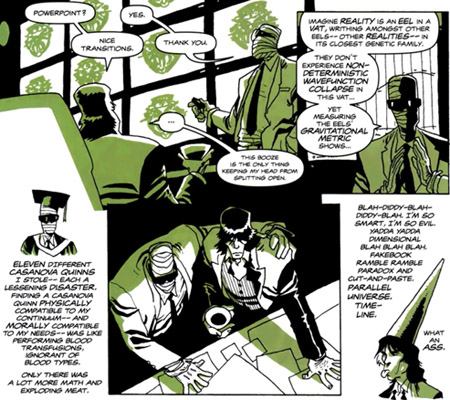
In the meantime, I’m reading Glen Hirshberg’s The Book of Bunk and Matt Fraction’s Casanova. I’ll talk about Glen’s book when I’m finished. I’d also like to get my hands on a scanner so I can write reviews of graphic novels like Casanova, too. It’s a crazy book, in the way Grant Morrison is crazy. But Fraction has a better sense of humor.

A page from Casanova. I love the reality-tv style intercuts, with the characters breaking the 4th wall to give us the real scoop.

Post-amusement park breakdown, with red wine accompaniment

Mia hamming it up in front of the palace.
So we’re back. We spent yesterday at Disney World and today at Universal Studios. I’m sitting up late listening to Ani DiFranco (yeah, you heard me, pal) and drinking my second glass of red wine. I’m also dead tired, though my brain has yet to understand this, so this post may devolve into stream of consciousness.


What struck me about Disney World — aside from the almost military rigidity with which everyone smiles and wishes you “a magical day!” — was that it has not changed one bit from the last time I was there. Which was over 25 years ago. While that means it retains a certain nostalgic appeal to people my age, it also means that kids like my daughter feel slightly underwhelmed by the quaintness of some of the rides. I was talking up the virtues of “Pirates of the Caribbean” and “The Haunted Mansion” for a good week before we finally got here. And although I still enjoyed them both — particularly the mansion, which had some pretty sweet looking ghosts — Mia was clearly less than impressed.  I could acknowledge the fact that perhaps 10 years old is beyond the sweet spot for these rides, and that maybe I should have taken her two or three years ago, but that would be admitting to some personal responsibility for this situation, which is counter to the purpose of my post, so I’ll leave that part out.

I did get her to go on Space Mountain, though, which wound up being her favorite, and scaring the bejesus out of me. Not knowing where you’re going on a rollercoaster makes all the difference. I am too old and frail of mind for that kind of nonsense.

The view from our hotel balcony. That's the Magic Kingdom on the left and Space Mountain on the right. You see that clear blue sky, Northern readers? That's what January looks like in Florida.
We stayed in a hotel on the grounds. We had a 14th floor room with a fantastic view. She got to go to sleep staring at the Magic Kingdom, all lit up in purple and blue, which is a pretty big deal for a 1o year old girl. She was deeply impressed by the room, and the view it afforded her. I told her it was because we were fancy people, which she accepted as a logical explanation; henceforth we were careful to announce our approach to the great clots of unwashed humanity blocking our lanes of passage: “Stand aside! Fancy people coming through!” I was only punched four times.


Universal Studios was a lot more fun. Some of the “rides” were ridiculously cheesy, though. For example, the Terminator ride starts out promisingly enough, with real terminator robots rising from the floor in clouds of steam and actors dressed as security personnel running around in feigned panic. But it devolves into a static, hackneyed confrontation between Schwarzenegger and John Connor stand-ins against the new terminator model, T-1,000,000 (yes, I’m afraid so). Still, it petrified my kid, who clutched my sleeve and pleaded with me to remove her from danger, while I laughed with callous disdain. That’s a win in my book!

Nevertheless, the attractions at Universal were livelier and far more engaging. Even the actors, who normally irritate the hell out of me at these sorts of things, were very good. The Harry Potter section was pretty spectacular. (Yes, I like Harry Potter. I know, I have to turn in my Real Writer Card now. I don’t even care. It’s fun, damn you. Bear in mind I would not admit to this if I hadn’t had two glasses of wine.) Hogsmeade was rendered with wonderful specificity; I even took Mia into Honeydukes sweets shop where she bought those jellybeans with the bewildering assortment of flavors. She gave me the earwax jellybean on the drive home; after I bit into it, it was ejected from the car with extreme prejudice.

We actually ran out of time before we got to do everything we wanted to. I had to walk through the Marvel Superhero village without stopping at any of the stores. That hurt my heart.

Her favorite attraction was Twister, which replicated the experience of watching a pickup truck slide into a gas line in some unnamed town in Kansas. There was fire. There was rain. There was a flying cow.

Sadly, Mia did not survive the experience.

I’ll go again when I make a new kid.

Was it worth it? Yes. Yes it was.

Florida-bound

Waiting for takeoff in Charlotte
Today Mia and I headed down to Florida to visit my dad. The last time I took her to Florida was back in 2004; she was four years old. This time we’re going to do it right: Disney World tomorrow, followed by a night at the hotel there, and the Universal Studios Theme Park the following day. Saturday I’ll take her down to the docks, so she can feed some pelicans and I can show her the old Vinoy Hotel, which I believed was haunted when I was her age. This is the first real vacation I’ve taken with her in years, and I think I might be as excited about it as she is.

It started off on a sour note: the airport called first thing in the morning and informed me that the first leg of our flight — from Asheville to Charlotte — had been cancelled. While I never received an official word as to why, it’s clear to me that the threat of snow panicked somebody in the airport hierarchy. Asheville is famous for this; earlier this week school was cancelled because of the possibility that there might be some snow. It ended up being a bright, wet day with temperatures in the mid-forties.

Anyway, I just drove to the Charlotte airport and we took what would have been our connecting flight to Tampa. She hadn’t been on an airplane since our last trip down, and everything was new to her. She ran to the big terminal windows and exclaimed at everything she saw. She pointed to every plane we passed: “Is that ours, Dad? Is that one ours?”

It reminded me of how she was when she was years younger. It lit me up.

Once on the plane, though — after the initial thrill of being aboard, and before taking off and watching the world fall away below us — she was all business. That’s right: she busted out three days’ worth of math homework and did it all.

My girl is hardcore.
Now she’s asleep in her grandfather’s house, and tomorrow she gets to go to Disney World for the first time.

Sometimes you remember what life is for.

A New Orleans memory: the shapeshifter

The Avenue Pub, where I worked for seven great years

It was a weeknight at the Avenue Pub. I was behind the bar and the usual crowd was there: Monte, Maura, Neal, Jim, and a few servers from Bravo and Houston’s, the restaurants across the street. Not to mention the standard flotsam of the city, strangers and stragglers who wash ashore onto any barstool on any given night. The tv was muted and tuned to ESPN, and the jukebox was cranked up loud. People were playing pool. It wasn’t busy, but it was steady, like any good weeknight in the Lower Garden District. It was around 10 pm; I had a good four hours left before Darren came in to relieve me for the graveyard shift.

The way the Pub is set up is kind of strange. The bar itself is on the corner of St. Charles Avenue and Polymnia Street, but the parking lot is about a quarter of a block down. You had to walk a little ways in the dark to get there, and that was sometimes a risky proposition. Not often, but muggings had been known to happen. Most people parked along the street right outside, or used cabs or the streetcar, but sometimes it couldn’t be helped.

So when one of the waitresses from across the street came back in only minutes after having paid her tab and left, saying there was someone weird out in the parking lot, we all paid attention.

“Have you seen him in here before?” I said, walking around the bar.

“No. He’s some old dude. He’s standing out in the open and he’s got a big stick.”

Well, hooray.

I have this thing — it probably would have gotten me killed eventually, if I had stayed a bartender — but I rarely feel fear. At least, not from physical confrontation. I’ve found that most people will back down when directly confronted.  Nobody wants to get hit. I’m a peaceful guy, but I remember I used to look forward to stuff like this. Something in me wanted the confrontation. But the idea of being brained with a stick managed to dampen my enthusiasm.

Monte and the waitress came behind me (I wish I could remember her name). The night was warm, but not hot. It must have been early spring. Clouds scudded across the sky: a cloudless night in New Orleans is a rare thing. We walked down to the parking lot and sure enough, there was this old guy, clearly homeless, standing in the middle of the parking area with the massive branch he’d yanked from some luckless tree. He was peering into some bushes with his back to us.

“Hey!” I said, walking toward him. “What’s going on?”

I stopped outside of the reach of his stick. He turned to look at me, squinted for a minute. “You’re not one of them,” he said.

I’m pretty good at speaking Crazy. I’ve spent a lot of time around it. (Which was a lucky thing, because my experts in the dialect — Sunbeam, Naked Mary, the lady who lit fires to magazines and warned of the robot uprising, or any of the others — were not there that night to be consulted.) I intuited right away that not being One of Them was a favorable condition in which to find oneself. “No, I’m not,” I said. “You can’t be out here, man. You’re freaking people out.”

He ignored me. “Do you see it?” He gestured to the bushes with his stick. “It’s a shapeshifter.”

“I don’t see anything.”

“Well it was there a second ago.”

“He probably ran away when he saw that big-ass stick.”

“You’re not one of them,” he said. He looked back towards where the parking lot met the street, where Monte waited beside the waitress. “She might be though.”

“She’s not. She’s my friend. I can vouch for her.”

He nodded. “Okay then,” he said.

“If you stay here, someone’s going to call the police,” I said. “You’re scaring people.”

“Okay. I don’t want to bother anybody.”

“Can I have that stick in case it comes back?”

He handed it over. “Be careful, brother,” he said.

“I will.”

He ambled off into the night. The waitress got back into her car and drove home, and Monte and I went back inside and knocked down some Jameson’s. I would say normal life resumed, but it was never really interrupted.

New Orleans is brimming with deranged people. Often, there’s nowhere for them to go. A lot of them are homeless, and are just trying to survive in whatever strange manifestation of the world their illness presents to them. As with most people who are on the edge of doing something stupid, talking to them with a hint of reason and respect will sometimes bring them back down.

I guess it was just dumb luck that he didn’t think I was a shapeshifter and try to brain me with that great big tree branch of his. But it was probably little more than dumb luck that allowed him to stand there in the night, white-bearded and stout, holding the monsters at bay with nothing more than a stick in his hand and a vigilant heart.

Father Geek

I don’t think Mia realizes what I’m doing to her. That’s probably a good thing. By the time she does, she’ll be too wrapped up in the latest Fantasy Flight boardgame or the newest Marvel comics crossover event to be too angry with me. (At least, that’s what I’m counting on.)

I’m turning her into a geek. Not on purpose. It’s just the atmosphere of our lives. She has no choice but to breathe it in.

I started, of course, with my writing. When she was very little she would ask me what I was writing about. When I told her I wrote fantasy stories, she started writing and illustrating her own. She would even fold the papers in half so that they looked like books. There were stories about lonely aliens and robots who ate people and then felt bad about it afterwards. I still have these. They’re brilliant.

It didn’t really catch fire, though, until I started turning Sundays into game days. We’ve had a revolving roster of players, but the stalwarts have been Jeremy and Alexa Duncan. (Alexa, by the way, has begun selling regularly to F&SF under her full name — Alexandra Duncan — and has already caught the attention of people like Ursula K. LeGuin. Click the link to her blog on the sidebar over there.) We played role playing games for a long time, and she would listen in rapt attention as her dad and his friends started telling a sort of story, bursting with a fascinating roster of characters and surprising predicaments. It occurred to me at the time that this pastime — which has been unfortunately stigmatized by popular culture as the hobby of social misfits and unwashed, basement-dwelling freaks — was being introduced to her as a completely natural way to spend an afternoon. It was defined by friends getting together, sharing breakfast, laughing, talking about books and language and history and, best of all, telling a communal, evolving story.

Later we set that aside for a while and moved on to board games, of which there is an amazing variety. The first grown-up game she sat in for was Talisman. Oh my God, did she love Talisman. It’s a quest game, where each person plays a standard fantasy character — dwarf, sorcerer, ghoul — and struggles to gain the power necessary to grab the Crown of Command, which will grant dominion over the world. Silly stuff. But the game is great fun, and Mia took to it like a shark to a kiddie wading pool. She was ruthless.

(She still is. The four of us recently sat down to a game of Mag-Blast, a card game about space warfare, and she announced her intention of reducing us all to flinders. Knowing her bloodthirsty nature, we took her seriously and attempted to beat her back. Whereupon she calmly and systematically annihilated each and every one of us in turn. It was brutal and beautiful.)

Then she started eyeballing my comic books. I have quite a collection. I don’t go for the single issue nonsense; I like big collections, so I can read a full story. And because I’m a book nut, I like nice hardbound copies if I can get them. So I took a few down to break her in. I gave her Ultimate Spider-Man, so she could read about him from the beginning. I gave her The Incredible Hulk, since she liked the movie so much. Then Mark Waid’s run on The Fantastic Four. She was okay with them, but she didn’t really get excited until she discovered Black Widow, the Russian assassin and occasional Avenger. Once she did, she had to read everything about her.

And then — my crowning achievement and the true hallmark of her descent into geekdom — came Lovecraft. She was already familiar with the aesthetic of the Cthulhu mythos because, well, because I’m her dad and I don’t know if a week goes by that I don’t reference it somehow. When she was eight she made me a Christmas card of Cthulhu wearing a Santa hat. Shit was tight. Last year, she asked if she could read him, and we went to Barnes and Noble and shared a very profound moment between father and child: the purchasing of her very first H.P. Lovecraft anthology. It the same one I started with, lo those long years ago: Bloodcurdling Tales of Horror and the Macabre: The Best of H.P. Lovecraft, with that nightmarish cover by Michael Whalen.

She went home that night and read “The Music of Erich Zann.” It’s not the one I would have chosen for her to start with, but she devoured it. And she raved about it. She couldn’t stop talking about it for days.

A few days later, sitting over dinner, she said, “Daddy, I memorized a poem.”

“Oh? Let me hear it.” I was expecting something from school. Maybe a short one by Robert Frost or William Carlos Williams.

She said, “That is not dead which can eternal lie/ And with strange eons, even death may die.”

I shed a small tear. I kissed her sweetly on the forehead.

She got a second helping of ice cream that night.

Writing around the heart

The problem with writing about raw emotion is that feelings keep getting in the way.

A couple weeks ago, Lucius Shepard posted this question to his Facebook profile: “I rarely write about stuff that’s going on in my head at the time–it seems to take around ten years for life to manifest in stories and my protagonists are often a decade younger than I. There are exceptions provoked by extreme emotion, but this is the general rule. What’s your lag time…or do you have one?”

It provoked a thread of 60 responses. I found the question particularly interesting, especially his clause about extreme emotion. Because that’s precisely where I differ. I need time to pass before I can get enough perspective and clarity on an emotionally charged issue to write about it effectively. I if I write from a place of high feeling, the writing gets too heated. It’s as though I’m trying to convince the reader of something and I just won’t shut up about it. I have to throw in every last detail of how I felt or why I felt it so that the reader can understand it, and justify everything I’m saying. Justify me. It becomes an exercise in validation, which — in my case at least — does not make for good writing.

Last year I went through an experience that so filled my head — my thoughts, my imagination, the way I thought about the world — that I found it impossible to write about anything else. When I tell you what happened it will sound laughably mundane: I fell in love and it didn’t work out. It happens to everyone. And really, the emotional fallout from it was way out of proportion to how long things lasted. And that’s a great topic to write about. I knew it at the time, and I made a few attempts. But each time my heart would start swinging through my chest like a wrecking ball, just demolishing everything in there, and I’d stall out.

The reason was that the story is not simple. It would take time and, above all, clarity to write about truly and honestly. There were so many factors that went into it, and that went into my profound reaction to its failure. I could write a book. And, now that time has passed and I have achieved that clarity, I probably will.

Going further back, there are other moments of high emotion that are quite easy for me to write about, now that I’ve established emotional distance. Family drama from when I was a kid; my first few love affairs; events in the bar I worked at in New Orleans in which I was afforded a glimpse into both the strengths and weaknesses of my character, when I confronted real fear and am now able to study my own reactions to it. There are essays and blog posts aplenty about my New Orleans experience alone, let me tell you.

But if I had tried to write about any of it at the time, it would have been a feverish mess. I know, because I did try, and I’ve seen the results.

I wish I could be one of those people who can throw things down on the page in the high crest of emotion and have something beautiful come out of it. I think of the Romantic poets and I imagine that’s how they did it. (I have no idea if this is actually true.) I’m reminded of songwriters like Citizen Cope and Glen Hansard, who seem to be able to tap all that passion and tumult and turn it directly into art. Who aim their hearts at you like cannons.

But for all I know it took Hansard a month to get that song just right.

In any case, it takes me a while to settle down. It takes me some time to find a place I can look back from and see an event completely. And I can’t write about it the way I need to until that happens. I wonder sometimes if I’m more like a teenager than a grown man. I appear calm on the outside, but inside it’s all wind and high seas.

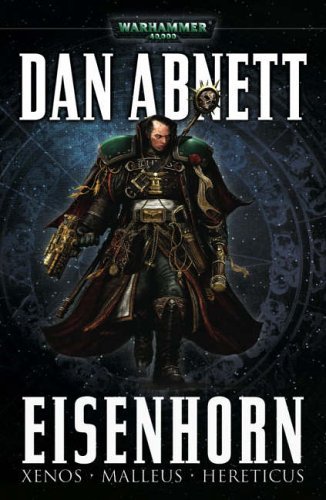
Guilty Pleasures: The Warhammer 40K fiction of Dan Abnett

They come in big, bulky paperback collections, each one about as thick as a Manhattan phonebook, each one containing three or four novels and sometimes a smattering of short stories. The covers are garish and bold: striding soldiers wearing ornate uniforms, jaws clenched and firing baroque autorifles directly at your face. You cannot carry one of these books around with you and pretend that it is anything other than what it is: balls-out war fiction.

These are not the books I take with me when I expect to be seen by friends or coworkers. I have an image as an uptight, emotionless bastard to uphold, for God’s sake. What would people think if they knew I liked reading about vat-grown space marines blowing the christ out of each other?

But I do. Oh God, I do. Especially if Dan Abnett is doing the writing. Let me try to explain.

I don’t remember now why I picked up Eisenhorn, Dan Abnett’s trilogy about an Inquisitor in the Warhammer 40K universe. The setting itself appealed to the wide-eyed little boy in me: enormous spaceships which looked more like Gothic cathedrals than the sleek bullet-shaped vessels I’d grown accustomed to; a dead god-emperor whose residual psychic energy acted as the compass that made interstellar travel possible; the human race as a guttering candle as it finally confronted its own unavoidable extinction. But I knew better than to dive headlong into the world of licensed fiction. Didn’t I? Well … I guess I was just desperate for something new.

Eisenhorn begins with the eponymous character landing on a frozen world, pursuing the recidivist Murdin Eyclone through precincts of the hibernation tombs, where the elite members of that planet sleep through the long winter, “dreaming in crypts of aching ice.” Custodians patrol the grounds with lighted poles and heat-gowns. “Above, star patterns twinkled in the curious, permanent night.” This was not clumsy writing. The setting was enticing and I immediately recognized an easy facility with the language, a sense of rhythm and elegance — not at all what I was expecting to find. As he closes in on his quarry he starts to find the bodies. “A few metres insides, another custodian lay dead in a stiffening mirror of blood.” Gorgeous.

The action starts, quickly and precisely paced. And then, this bit of joy: Eisenhorn must communicate tactics to his pilot, waiting for him outside in his ship. He knows Eyclone is monitoring communication, so he employs Glossia, a shorthand vocabulary he invented, unique to his crew. In this segment Eisenhorn is communicating news of the death of one of their crew to the pilot, and offering instructions. Listen:

“Thorn wishes aegis, rapturous beasts below.”

“Aegis, arising, the colours of space,” Betancore responded, immediately and correctly.

“Rose thorn, abundant, by flame light crescent.”

A pause. “By flame light crescent? Confirm.”

“Confirm.”

“Razor delphus pathway! Pattern ivory!”

“Pattern denied. Pattern crucible.”

“Aegis, arising.”

In simple, beautiful language, consisting of nothing more than symbols, you get everything you need: the death explained, the shock and anger of the pilot receiving the news, the urge to fly in with guns blazing, and Eisenhorn’s insistence on discipline.

Abnett is best know for a series of books called Gaunt’s Ghosts, about an army of soldiers whose home planet fell to the enemy on the day of their founding. Each book in the series depicts a sustained military campaign. Writing compelling action is not as easy as it might seem, but Abnett rarely falters. Necropolis, a novel about a city under siege, is one of the most claustrophobic, harrowing novels I’ve read in years. I actually felt physically tired after finishing it.

Abnett’s strength is two-fold: he has an intimate knowledge of how a military operation functions and is able to communicate that effectively to a layman like me; and, more importantly, he understands that the strength of any story — particularly a war story, where life is at its most tenuous — is found not in the action but in its characters. None of these people receive short shrift. His quick, sure strokes in defining a sympathetic supporting cast rivals Patrick O’Brian’s in the Aubrey-Maturin series. From Rawne, the capable but murderously jealous major; to Brin Milo, the only civilian rescued from the army’s home planet, who becomes a symbol of what was lost; to Mad Larkin, whose psychology is so fractured that he can only apprehend the world clearly when he’s looking through the scope of his sniper rifle; these are characters that crackle with life.

What I’m telling you is, these books are the real deal. Dan Abnett is one of the best, most exciting writers in science fiction. And not enough people know it, because he writes licensed fiction.

At the risk trying your patience with the length of this post, I’ll close with this passage from the opening pages of First and Only, the very first book in the Gaunt’s Ghosts series. Abnett’s writing is, after all, its own best advocate. Here, a soldier named Colm Corbec is walking through a network of trenches in the morning as the sun rises, “heavy and red, like a rotten, roasted fruit.” He’s surveying the state of the men as they await the order to engage the enemy.

The dark stealth capes of the picket sentries, the distinctive uniform of the Tanith First and Only, were lank and stiff with dried mud. Their replacements at the picket, bleary eyed and puffy, slapped them on the arms as they passed, exchanging jokes and cigarettes. The night sentries, though, were too weary to be forthcoming.

They were ghosts, returning to their graves, Corbec thought. As are we all.

In a hollow under the trench wall, Mad Larkin, the first squad’s wiry sniper, was cooking up something that approximated caffeine in a battered tin tray over a fusion burner. The acrid stink hooked Corbec by the nostrils.

“Give me some of that, Larks,” the colonel said, squelching across the trench.

Larkin was a skinny, stringy, unhealthily pale man in his fifties with three silver hoops through his left ear and a purple-blue spiral-wyrm tattoo on his sunken right cheek. He offered up a misshapen metal cup. There was a fragile look, of fatigue and fear, in his wrinkled eyes. “This morning, do you reckon? This morning?”

Corbec pursed his lips, enjoying the warmth of the cup in his hefty paw. “Who knows … ” His voice trailed off.

High in the orange troposphere, a matched pair of Imperial fighters shrieked over, curved around the lines and plumed away north. Fire smoke lifted from Adeptus Mechanicus work-temples on the horizon, great cathedrals of industry, now burning from within. A second later, the dry wind brought the crump of detonations.

Corbec watched the fighters go and sipped his drink. It was almost unbearably disgusting. “Good stuff,” he muttered to Larkin.

Damn right it is.